
What Is Prime Cost in a Restaurant?
The prime cost in a restaurant determines whether your business generates a healthy profit or operates at a significant loss. Unfortunately, most operators track this number without ever actually controlling it.
Typically, owners focus their energy on increasing top-line sales. However, when your food and labor costs drift away from revenue targets, your hard-earned profitability simply disappears.
This disconnect causes many restaurants to suffer through the pattern explained in Busy Restaurant No Profit. In other words, strong sales fail to result in a positive bottom line because the core expenses are unmanaged.
Prime Cost Formula
This calculation defines your entire cost structure. Consequently, mastering these two specific elements remains the only reliable way to protect your margins from erosion.
⚡ Prime Cost Calculator
Calculate your prime cost percentage instantly.
What Is a Good Prime Cost Percentage?
| Concept | Target Prime Cost |
|---|---|
| Quick Service | 55%–60% |
| Fast Casual | 60%–65% |
| Full Service | 60%–70% |
While benchmarks provide a general direction, your actual success depends on disciplined execution. Therefore, the goal is absolute control rather than industry averages.
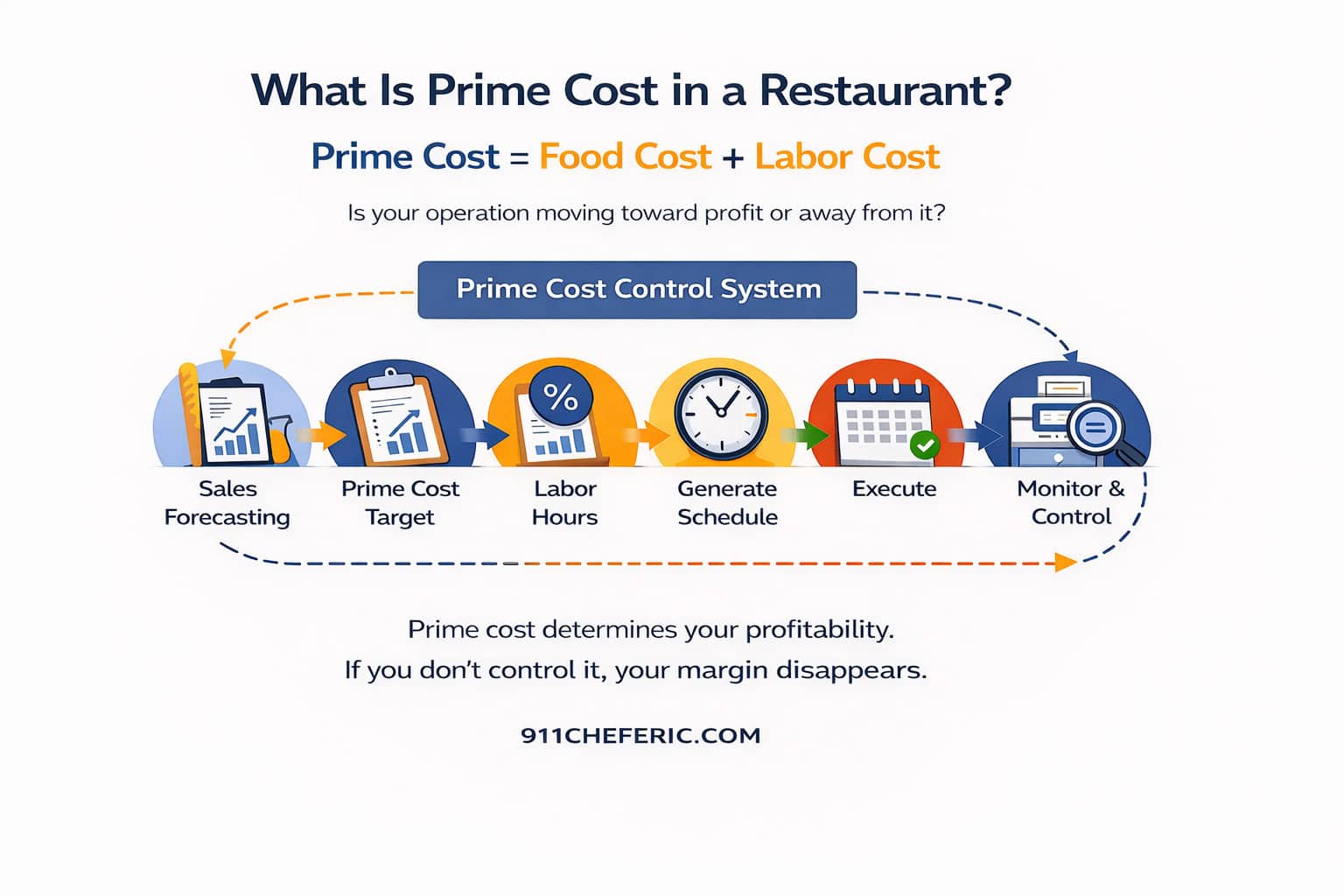
Prime Cost Is a System
Prime cost is not just a number. Instead, it operates as the output of multiple systems working together in harmony.
Specifically, these systems include:
– Accurate Sales forecasting
– Disciplined Labor scheduling
– Consistent Productivity tracking
– Rigorous Inventory control
To improve your results, learn how these critical metrics connect: Prime Cost Control System , Labor Cost Control System , and Sales Per Labor Hour . Understanding the intersection of these systems is the key to maintaining long-term profitability and operational discipline.
What Prime Cost Actually Tells You
Prime cost acts as a financial navigation system for your restaurant. It reveals whether your operation is aligned with your targets or drifting away from profitability.
Proactive operators tie prime cost directly to their weekly budget. Furthermore, every week, you must measure performance against defined target percentages to ensure long-term stability.
As a result, controlling prime cost is not optional. It is the core mechanism that protects your bottom line.
Strategic Takeaway
Prime cost determines whether your sales generate profit. Therefore, controlling it must be your primary operational priority.
You don’t control profit. You control prime cost.
Frequently Asked Questions
What is prime cost in a restaurant?
Prime cost is the combined total of food cost and labor cost. It represents the largest controllable expenses in a restaurant and directly impacts your overall profitability.
What is a good prime cost percentage?
A healthy prime cost typically ranges between 55% and 65%. However, this target depends heavily on your specific restaurant concept and operational efficiency within your control system.
How do you calculate prime cost?
To calculate it, add your total food cost to your total labor cost. Then, divide that sum by your total sales to determine your prime cost percentage.
Why is prime cost important?
Prime cost determines whether your sales actually generate profit. Without structured control, increasing your revenue will not improve your bottom line; instead, it often hides underlying waste.
Get Practical Restaurant Profitability Insights
Receive practical insights on restaurant profitability, cost control, menu engineering, and operational systems.
Or schedule a direct meeting with Chef Eric.
Book a Free Restaurant Consultation