
Restaurant Scheduling System for Labor Cost Control
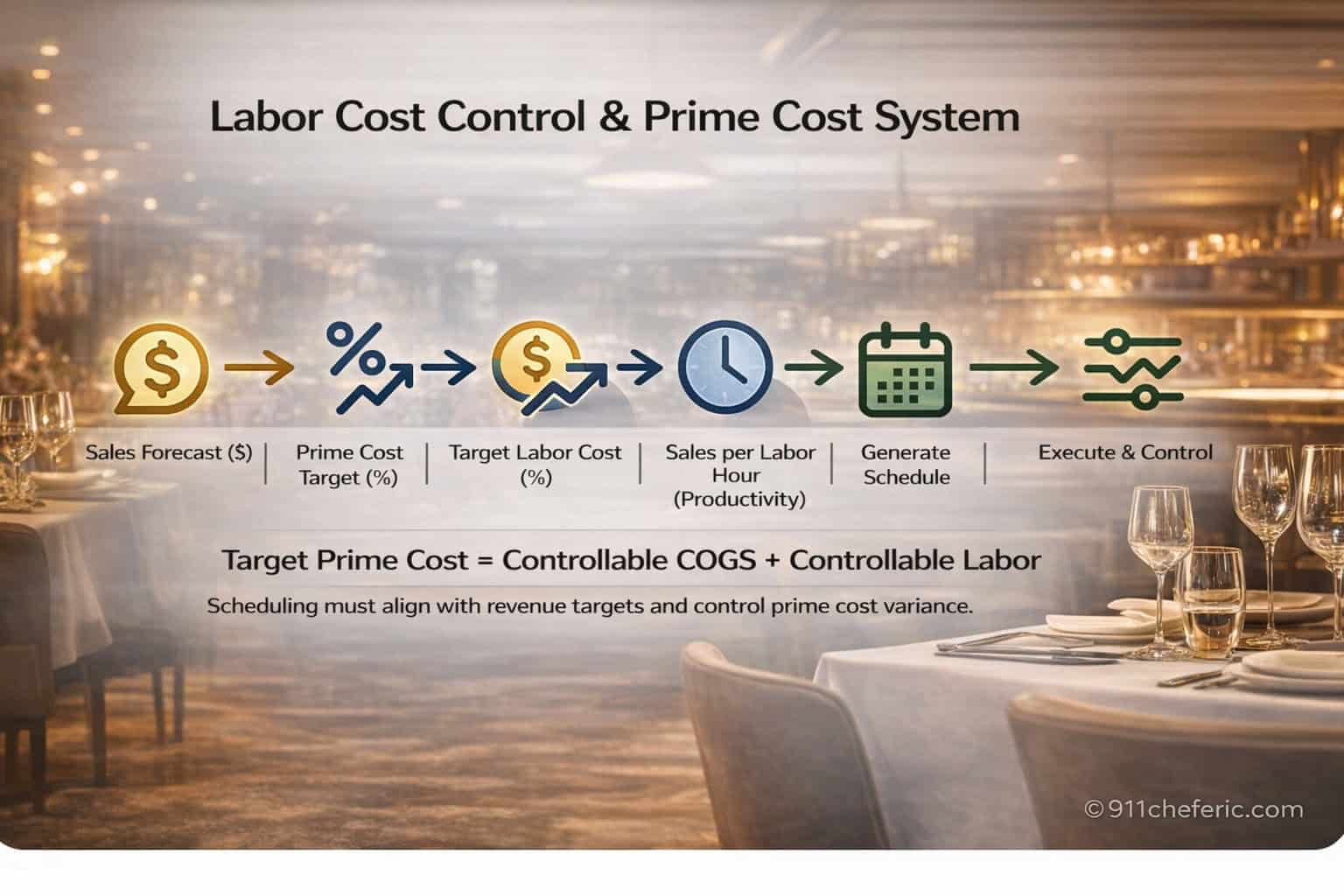
Restaurant scheduling system determines whether your labor cost is controlled or constantly drifting. In most operations, scheduling is treated as a routine task. However, it directly drives profitability.
Typically, schedules are built from habits or last week’s template. As a result, labor becomes disconnected from demand. Consequently, overstaffing increases while margins shrink.
Because of this disconnect, many operators experience the pattern explained in Busy Restaurant No Profit. In other words, strong sales fail to convert into profit.
At the same time, scheduling directly impacts your restaurant prime cost. Therefore, when labor hours exceed revenue capacity, profitability disappears quickly.
The Restaurant Scheduling System Explained
This system connects revenue expectations to labor planning. More importantly, it transforms scheduling into a measurable control process.
At the center of this system is SPLH (Sales Per Labor Hour). Therefore, labor can be calculated instead of estimated.
How to Calculate SPLH
For example, if your restaurant generates $5,000 in sales with 100 labor hours, your SPLH equals $50. In that case, each labor hour produces $50 in revenue.
Importantly, this calculation must include all labor hours: front of house, back of house, supervisors, and managers. Otherwise, the result becomes misleading.
Once your SPLH is known, you can define a target and apply it to your scheduling system. As a result, labor decisions become predictable and controlled.
⚡ Labor Hour Calculator
Calculate the maximum labor hours your forecast can support.
Enter your projected sales and target SPLH. Then, use the result as your staffing limit before building the schedule.
Before scheduling, define the maximum labor your sales can support. Therefore, this number becomes your limit—not your estimate.
Includes all staff: FOH, BOH, supervisors, and managers.
How to Calculate Labor Hours From Sales Forecast
| Step | Action | Example |
|---|---|---|
| 1 | Forecast sales | $6,000 |
| 2 | Set SPLH | $50 |
| 3 | Labor hours | 120 hours |
First, forecast your sales. Next, define your SPLH target. Then, divide sales by SPLH. As a result, your labor hours become clear before scheduling begins.
Scheduling Benchmarks by Concept Type
| Concept | Typical SPLH | Target SPLH |
|---|---|---|
| Quick Service | $60–$90 | $80–$120+ |
| Fast Casual | $45–$70 | $70–$110 |
| Casual Dining | $35–$55 | $55–$85 |
| Full Service | $30–$50 | $45–$75 |
While these benchmarks provide guidance, high-performing restaurants consistently operate closer to target SPLH. Therefore, your goal should be control, not averages.
Common Scheduling Mistakes That Increase Labor Cost
– Scheduling before forecasting
– Reusing outdated templates
– Ignoring SPLH
– Overstaffing “just in case”
– No accountability
As a result, labor cost increases while operational control decreases.
How to Implement a Restaurant Scheduling System
Step 1: Forecast sales
Step 2: Define SPLH targets
Step 3: Calculate labor hours
Step 4: Build schedule
Step 5: Track performance
Step 6: Adjust in real time
At this point, scheduling becomes a system output rather than a manual task.
Execution: Controlling Labor During Service
A schedule sets the plan. However, execution protects profit. Therefore, managers must track sales versus forecast throughout the shift.
If demand drops, labor must be reduced. Conversely, when demand increases, staffing must adjust. As a result, labor remains aligned with revenue in real time.
How Scheduling Impacts Prime Cost
Labor is one of the two components of prime cost. Therefore, scheduling errors immediately impact profitability.
When labor exceeds demand, margins shrink. Consequently, even strong sales cannot compensate for poor labor control.
From Scheduling Theory to Operational Execution
Understanding restaurant scheduling systems is one thing. Implementing them consistently across forecasting, labor planning, shift management, productivity tracking, and prime cost control is another.
Working with a restaurant consultant in Vancouver BC can help restaurant owners build practical labor control systems that improve scheduling accuracy, increase Sales Per Labor Hour (SPLH), reduce labor cost, and strengthen overall profitability.
Strategic Takeaway
Scheduling is not about filling shifts. Instead, it is about aligning labor with revenue. Ultimately, controlled scheduling protects profit.
You don’t schedule people. You schedule revenue.
Frequently Asked Questions
What is SPLH in restaurants?
SPLH (Sales Per Labor Hour) measures how efficiently labor generates revenue. It is calculated by dividing total sales by total labor hours. Learn more in our SPLH labor metric guide.
How does scheduling affect restaurant profit?
Scheduling directly impacts your restaurant prime cost. When labor hours exceed actual demand, margins shrink and your profitability becomes inherently unstable.
Should managers be included in labor calculations?
Yes. To maintain total operational control, all labor hours must be included—FOH, BOH, supervisors, and managers. Excluding any category leads to inaccurate cost reporting.
Can labor cost be reduced without cutting staff?
Yes. Improving forecasting, scheduling accuracy, and SPLH tracking allows for much better efficiency without the need to reduce your total team size.
Improve Restaurant Scheduling and Labor Cost Control
Restaurant scheduling systems should align labor with forecasted revenue, operational demand, and prime cost targets. Without structured forecasting and SPLH control, labor cost quickly becomes unstable.
Work with a restaurant consultant in Vancouver BC to improve labor forecasting, scheduling systems, operational execution, and restaurant profitability.