
How to Calculate Restaurant Prime Cost
(Step-by-Step Guide)
Understanding how to calculate restaurant prime cost is essential if you want to control profitability instead of reacting to it. In many operations, decisions are often made based on assumptions rather than data. However, when prime cost is tracked properly, it becomes a powerful operational control tool.
As a result, this guide walks you through each step clearly. In addition, it explains how to gather accurate numbers, apply the formula correctly, and interpret your results in a way that leads to better financial decisions.
Prime Cost Formula
Prime Cost = Food & Beverage Cost + Labor Cost
Prime Cost % = (Costs ÷ Sales) × 100
Quick Prime Cost Check
For deeper insights, use the full prime cost calculator →
What Is Restaurant Prime Cost
Restaurant prime cost combines food and beverage cost with labor cost. Together, these two components typically represent the largest controllable expenses in any food operation. Therefore, improving prime cost directly impacts profitability.
While many operators focus heavily on sales growth, cost control ultimately determines whether that revenue converts into profit. Consequently, even a small increase in prime cost can significantly reduce margins over time.
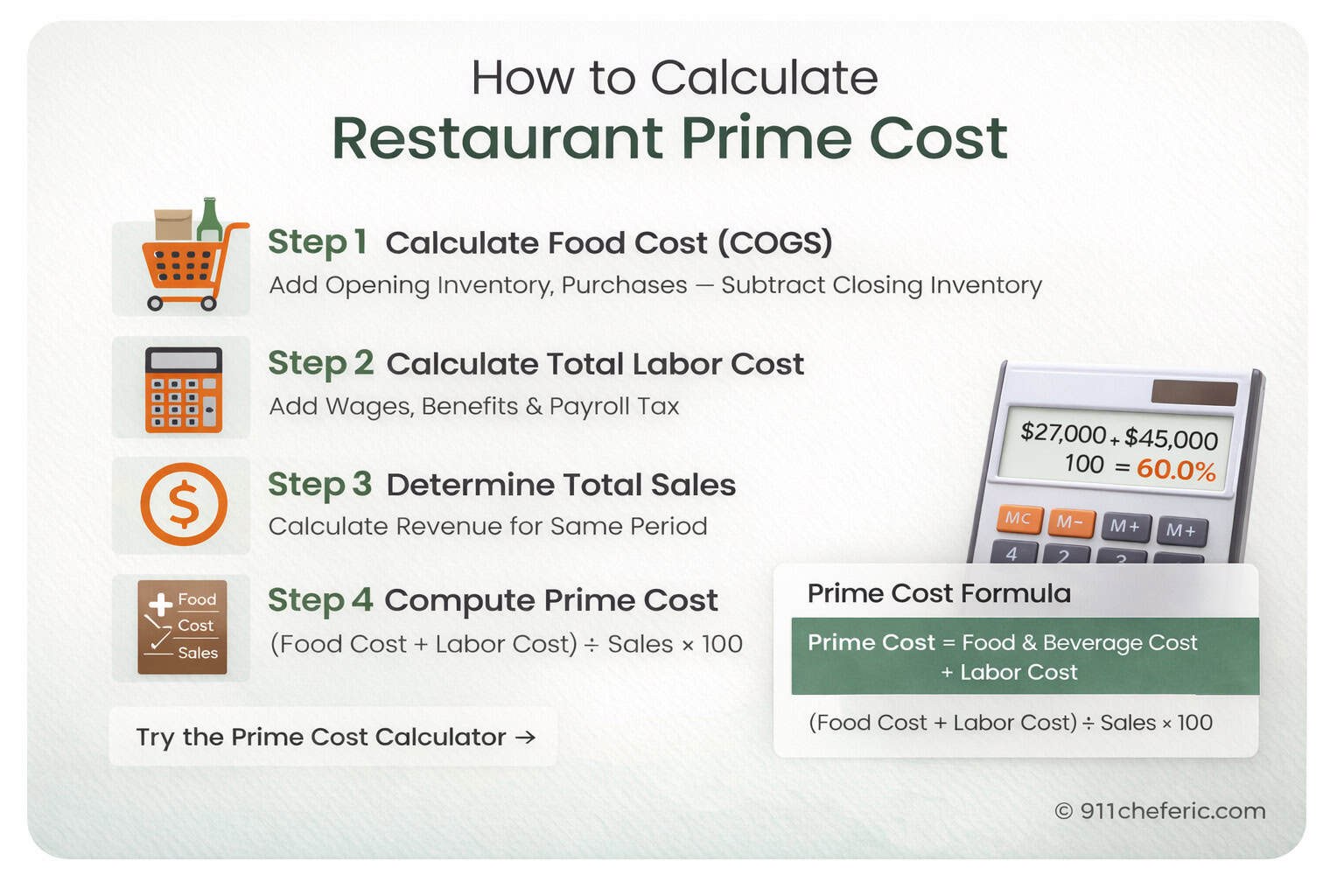
Step-by-step guide on how to calculate restaurant prime cost using food cost, labor cost, and total sales.
Step 1 — Gather Your Food & Beverage Cost (COGS)
To begin, calculate your cost of goods sold accurately. This requires consistent inventory tracking and disciplined purchasing records.
Because inventory fluctuations can distort results, weekly counts are essential. Otherwise, your data becomes unreliable.
Step 2 — Calculate Total Labor Cost (Fully Loaded)
Next, calculate total labor cost. However, wages alone are not enough. Instead, you must include all employer-related costs.
Since these additional costs are real expenses, excluding them leads to incorrect conclusions.
Step 3 — Determine Total Sales
After gathering your costs, calculate total revenue across all channels. In addition, ensure that the timeframe matches your cost data.
Consistency matters because comparing different periods creates misleading results.
Step 4 — Calculate and Interpret Your Prime Cost
Example:
COGS: $12,000 | Labor: $15,000 | Sales: $45,000 → Prime Cost = 60%
At 60%, margins are already under pressure. Therefore, identifying operational inefficiencies becomes critical.
In many cases, reducing prime cost by just a few percentage points has a greater impact than increasing sales. For example, improving yield or labor efficiency often produces faster results than trying to drive additional revenue.
Case Studies — Measured Operational Results
Each engagement focuses on structural correction, margin stabilization, and measurable performance improvement — not temporary fixes.
Improve Your Knowledge and Systems
Operational performance is not only about tracking numbers. In addition, it depends on structured systems, proper training, and consistent execution. For example, professional training platforms such as Online Culinary School provide deeper insights into kitchen systems, cost control, and operational consistency.
Diagnose Your Prime Cost Performance
If your prime cost is above 60%, you are likely losing profit every week.
If your prime cost feels inconsistent, your system is not aligned — and your profitability is at risk.