
Restaurant Labor Cost Control System: How to Align Labor With Sales and Protect Profit
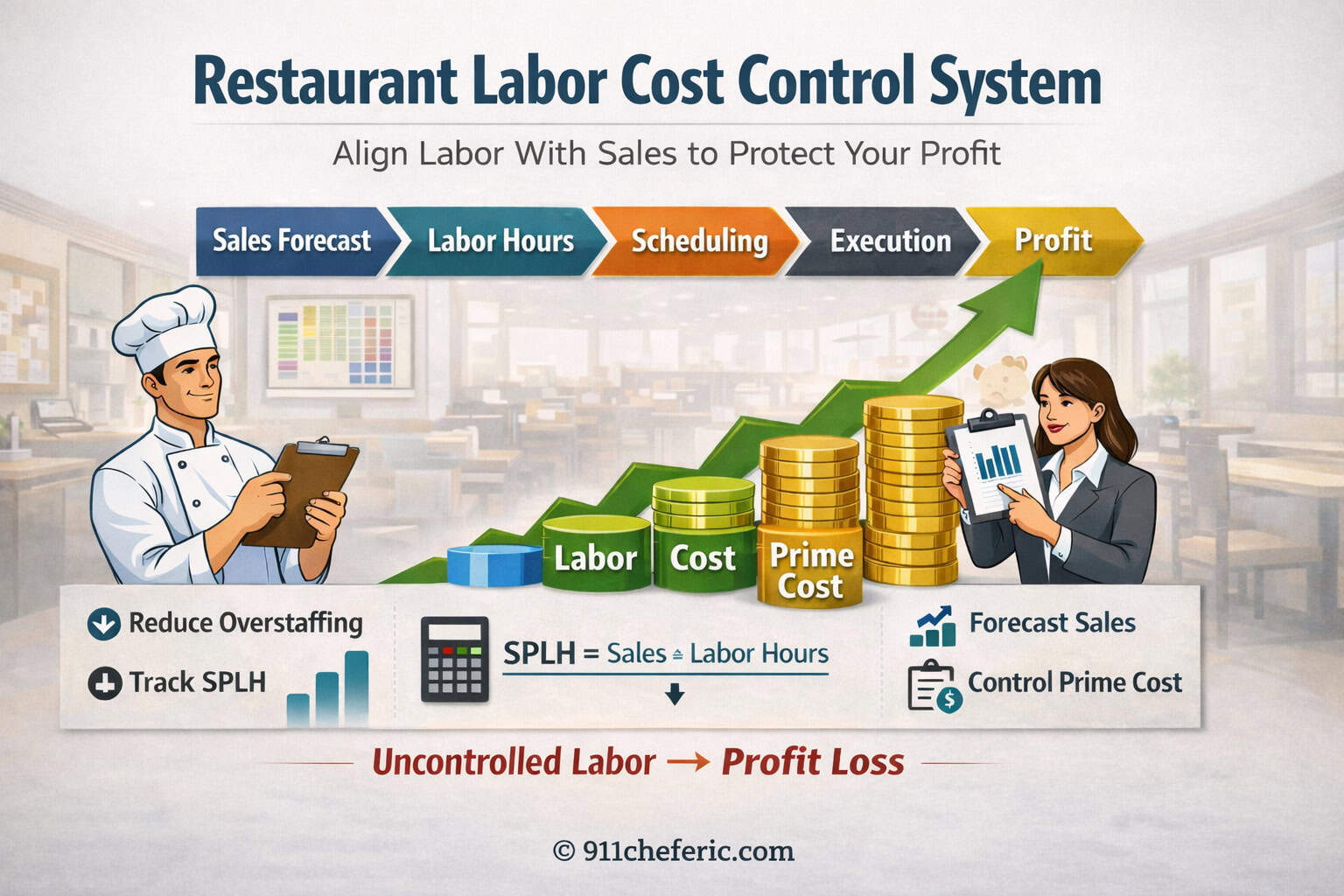
Restaurant labor cost control system determines whether your operation runs with control or constant instability.
In most restaurants, teams manage labor reactively. Schedules follow habits, pressure, or availability instead of data. As a result, labor cost rises, efficiency drops, and profitability becomes unpredictable.
If your restaurant is busy but still struggling financially, labor inefficiency is often the hidden issue. In many cases, this pattern is explained in Busy Restaurant No Profit, where strong sales fail to convert into real margin.
At a financial level, labor represents one half of your restaurant prime cost. Therefore, when labor is not aligned with sales, margins shrink regardless of revenue performance.
A restaurant control system requires labor to be structured, measured, and aligned with demand — not guessed.
Labor Cost Is Not a Staffing Problem — It Is a System Problem
Most operators assume labor cost comes from wages or staffing levels. However, the real issue comes from misalignment between labor hours and sales volume.
When schedules disconnect from demand, labor becomes inefficient. Teams end up overstaffed during slow periods and understaffed during peak service. Consequently, inconsistency and cost instability increase.
For this reason, labor cost is not controlled through reduction. Instead, it is controlled through alignment.
The Labor Cost Control System Framework
Each step must connect. If one element breaks, labor cost quickly becomes unpredictable.
Core Components of Labor Control
Sales Forecasting
First, labor starts with revenue prediction. Without a forecast, scheduling becomes guesswork.
Labor Hour Planning
Next, each shift must align with expected sales volume. This ensures staffing matches demand.
Scheduling System
Then, schedules must follow structure instead of emotion. Consistency stabilizes labor cost over time.
Execution Discipline
Finally, execution must match the plan. Even a strong schedule fails when teams ignore labor targets during service.
The Metric That Controls Labor: SPLH
Sales Per Labor Hour (SPLH) measures how efficiently labor generates revenue. When SPLH drops, labor cost increases immediately.
Therefore, tracking this metric weekly allows operators to identify inefficiencies and adjust scheduling decisions proactively.
How Labor Impacts Prime Cost
Labor and food cost together form your restaurant prime cost. Restaurants looking to improve both labor and food cost performance often benefit from working with a restaurant consultant in Vancouver BC to implement structured operational systems.
In addition, labor efficiency depends on revenue performance. When sales execution weakens, labor cost increases as a percentage of revenue. See front of house revenue system to understand how sales behavior impacts labor efficiency.
At the same time, labor and food cost must be managed together. Reducing labor without controlling food cost creates imbalance. Likewise, controlling food cost without labor alignment limits profitability.
Furthermore, labor misalignment often appears alongside food cost variance. To understand this relationship, review theoretical vs actual food cost.
All of these elements connect inside a restaurant control system, where operational decisions protect margin consistently.
Common Labor Cost Failures
Most labor issues follow predictable patterns:
– Overstaffing “just in case”
– No sales forecasting
– Static schedules that ignore demand
– No labor performance tracking
– Emotional scheduling decisions
Because of these patterns, cost instability increases and profitability declines.
What Controlled Labor Looks Like
| Control Level | Labor Performance |
|---|---|
| System-controlled | Aligned with sales, stable SPLH |
| Partially controlled | Inconsistent scheduling |
| Reactive | Overstaffing and cost spikes |
Implementation: Where to Start
Start by measuring your current labor performance using weekly SPLH. Then align schedules with sales forecasts and adjust staffing based on real demand instead of assumptions.
After that, integrate labor tracking into your overall system to ensure consistency across all operational decisions.
Implementing Labor Control Systems
Many restaurant operators understand labor cost concepts but struggle with implementation. Forecasting, scheduling, productivity tracking, accountability systems, and operational discipline must work together to create consistent results.
Working with a restaurant consultant in Vancouver BC can help identify labor inefficiencies, improve scheduling systems, strengthen SPLH performance, and build operational controls that protect prime cost and profitability.
Restaurant Systems Support in Vancouver and Beyond
Whether you operate in Vancouver or another market, labor instability rarely comes from staffing alone. More often, it results from missing structure and inconsistent execution.
Through system implementation, operators align labor with demand, stabilize scheduling, and protect profitability.
Strategic Takeaway
Labor is not a fixed expense. Instead, it functions as a controllable system.
When labor aligns with sales, cost stabilizes. However, when alignment breaks, profit disappears.
Ultimately, controlling labor means controlling half of your profitability equation.
If labor is not aligned with sales, profit is not under control. — Chef Eric
Frequently Asked Questions
What is restaurant labor cost?
Restaurant labor cost includes wages and payroll expenses and represents a major part of your restaurant prime cost.
What is a good labor cost percentage?
A typical range is 25%–35%, depending on concept and service model. However, consistent control within a restaurant control system matters more than averages.
How do you reduce labor cost in a restaurant?
You reduce labor cost by aligning scheduling with sales, improving execution, and integrating labor into your operational systems.
What is SPLH in restaurants?
SPLH (Sales Per Labor Hour) measures how efficiently labor generates revenue and directly impacts your restaurant prime cost.
Labor Cost Problems Are System Problems
If your labor cost feels unpredictable, the issue is usually not your team — it is the system behind forecasting, scheduling, productivity tracking, accountability, and execution.
A structured labor cost control system aligns staffing with sales, improves SPLH performance, stabilizes prime cost, and protects profitability.
As a restaurant consultant in Vancouver BC , I help restaurant owners identify labor inefficiencies, implement scheduling systems, improve operational controls, and build more profitable restaurants.