
Hiring More Staff Won’t Fix Your Kitchen
Better Systems Will.
Rising labour costs are not solved by hiring more staff. We restructure your kitchen systems to improve speed, consistency, and profitability.
Labour Cost Pressure Is Increasing — But Productivity Isn’t
The real issue is not labour shortage. It’s system efficiency.
Restaurant labour cost optimization is one of the most critical drivers of profitability in today’s foodservice industry. As wages continue to rise and staffing shortages persist, operators face increasing pressure on margins. However, hiring more staff rarely solves these challenges. Instead, without structured systems in place, additional labour often increases costs without improving performance.
Most kitchens see measurable improvements within 2–4 weeks once systems are properly structured.
Independent Restaurants
Improve margins and stabilize labour %
Multi-Unit Operations
Standardize performance across locations
Hotels & Hospitality
Optimize complex kitchen environments
Institutional Kitchens
Improve output within fixed staffing
Why Hiring More Staff Doesn’t Improve Labour Cost Optimization
In many kitchens, adding staff increases operational complexity rather than improving efficiency. As a result, productivity often remains unchanged while labour costs continue to rise. More importantly, teams become harder to manage and execution becomes inconsistent. By contrast, effective restaurant labour cost optimization focuses on improving how work is performed instead of increasing headcount.
- Higher labour cost with limited productivity gain
- Slower service due to inefficient workflow
- Inconsistent execution across shifts
In most cases, kitchens that implement structured systems see measurable improvements within 2–4 weeks, while labour cost reductions typically range between 8% and 18% depending on operational complexity.
How Restaurant Labour Cost Optimization Systems Work
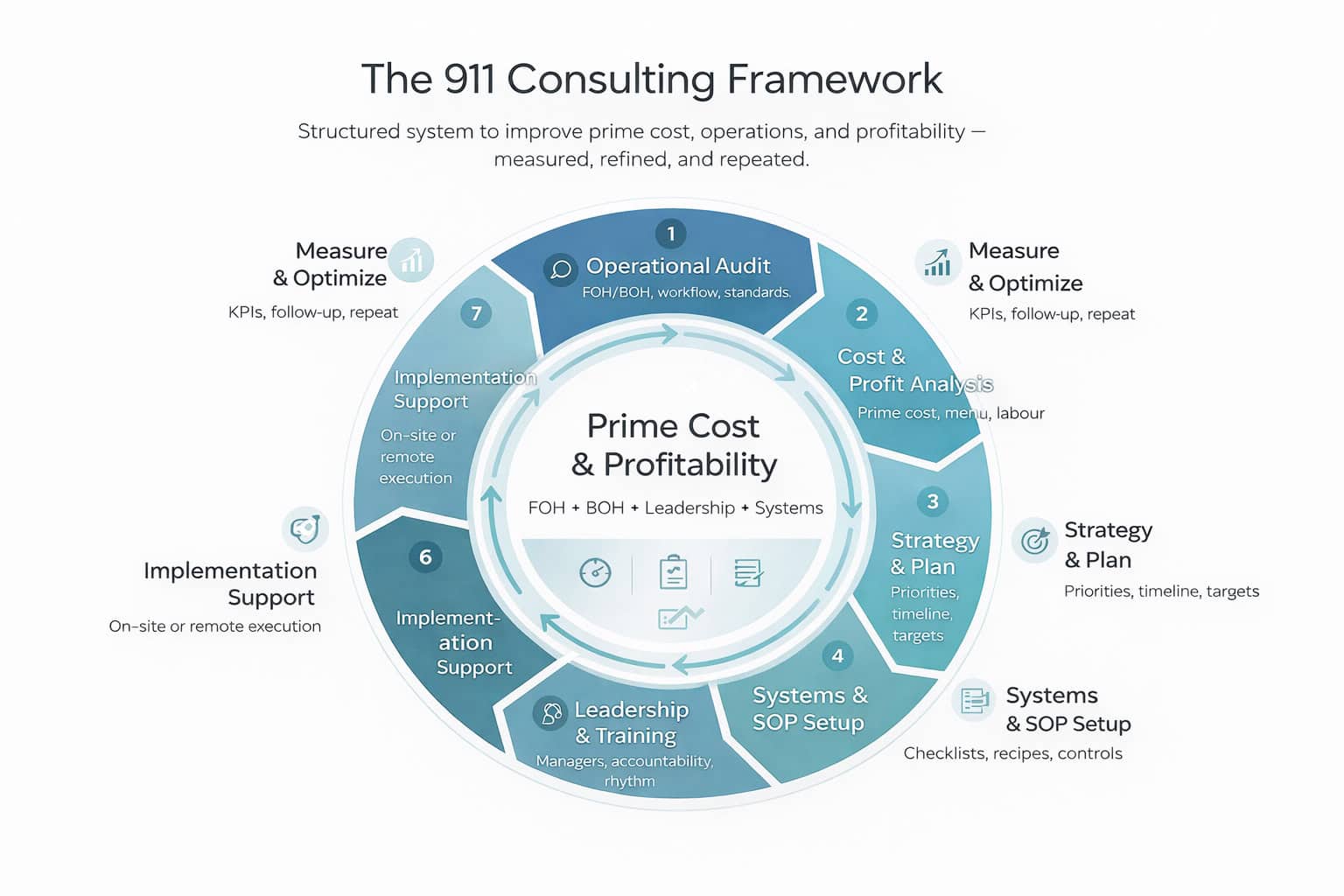
Rather than relying on staffing increases, structured systems create sustainable improvements. To begin with, performance must be measured accurately. Then, workflows and processes are aligned to eliminate inefficiencies. Finally, consistent control ensures that improvements are maintained over time. As a result, performance becomes more predictable and scalable.
Measure
Track labour %, SPLH, prep time, and output.
Align
Optimize workflows, menus, and staffing structure.
Control
Maintain consistency through systems and standards.
How We Work With Your Team
First, we analyze your current labour data, kitchen flow, and service patterns to understand where inefficiencies occur.
Then, we identify bottlenecks, gaps in execution, and areas where productivity is being lost.
Next, workflows, prep systems, and station structures are redesigned to reduce wasted movement, improve speed, and increase output per labour hour.
After that, we implement practical systems directly with your team to ensure changes are applied correctly.
Finally, performance is tracked and refined over time, so improvements remain consistent and measurable.
Can Government Funding Cover This?
Many restaurant owners assume this type of work is expensive. However, in many cases, government funding can cover a significant portion of it.
In many cases, yes. Across Canada, workforce training programs can cover a significant portion of structured operational training when it aligns with productivity and workforce development goals.
Most restaurants typically access between $5,000 and $15,000 in funding, while larger teams or multi-location groups may qualify for higher amounts depending on structure and eligibility.
However, approval is not automatic. Programs must be properly designed, documented, and aligned with funding criteria — which is where most applications fail.
We help structure your training so it not only improves your operation, but also maximizes your chances of approval.
Available across Canada • English & French support 🇨🇦 🇫🇷
Systems That Improve Labour Cost Optimization
Menu engineering, prep optimization, station design, and workflow restructuring all contribute to improved performance.
Industry Reality
According to Statistics Canada, labour remains one of the highest operating costs in restaurants. We work with restaurants across Vancouver, British Columbia, and Canada to improve labour efficiency and operational performance.
Case Example — Labour Optimization in Practice
Before
- Labour cost above 34%
- Slow service
- Inconsistent prep
After
- Labour cost reduced 12–18%
- Improved speed
- Consistent execution
Hiring More Staff vs Fixing Systems
| Approach | Impact | Outcome |
|---|---|---|
| Hiring More Staff | Higher cost | Short-term relief |
| Fixing Systems | Lower cost | Long-term control |
Results You Can Expect
- Lower labour cost percentage
- Improved speed
- More productive team
- Better operational control
- Higher profitability
Signs It’s a System Problem
If your team is busy but output is inconsistent, or if labour costs keep rising without better performance, the issue is likely workflow and structure—not staffing.
Frequently Asked Questions
Most restaurants see improvements within weeks after implementing changes.
No. The focus is on productivity, not cutting staff.
Yes. These systems apply to operations of all sizes.
No. Systems improve consistency and execution.
It improves productivity and reduces labour cost without reducing output.
Fix Your Labour Cost — Without Adding More Staff
In 20 minutes, we’ll identify where your kitchen is losing time, money, and efficiency — and how to fix it.
No disruption. Works with your current team.