
Restaurant Food Safety Audit: Complete Guide
A restaurant food safety audit is one of the most effective tools for identifying risks, maintaining compliance, and protecting customers from foodborne illness. While health inspections provide regulatory oversight, food safety audits allow restaurant operators to proactively evaluate their systems before problems occur.
Unfortunately, many food businesses only focus on compliance when an inspection is scheduled. As a result, food safety issues often go unnoticed until violations are discovered by regulators, customers, or employees.
By conducting regular audits, restaurant owners can identify weaknesses, improve staff performance, strengthen documentation, and reduce the likelihood of costly violations. Furthermore, audits help create a culture of accountability and continuous improvement throughout the operation.
This guide explains how restaurant food safety audits work, what auditors evaluate, common violations, corrective actions, and how audits help prepare restaurants for health inspections.
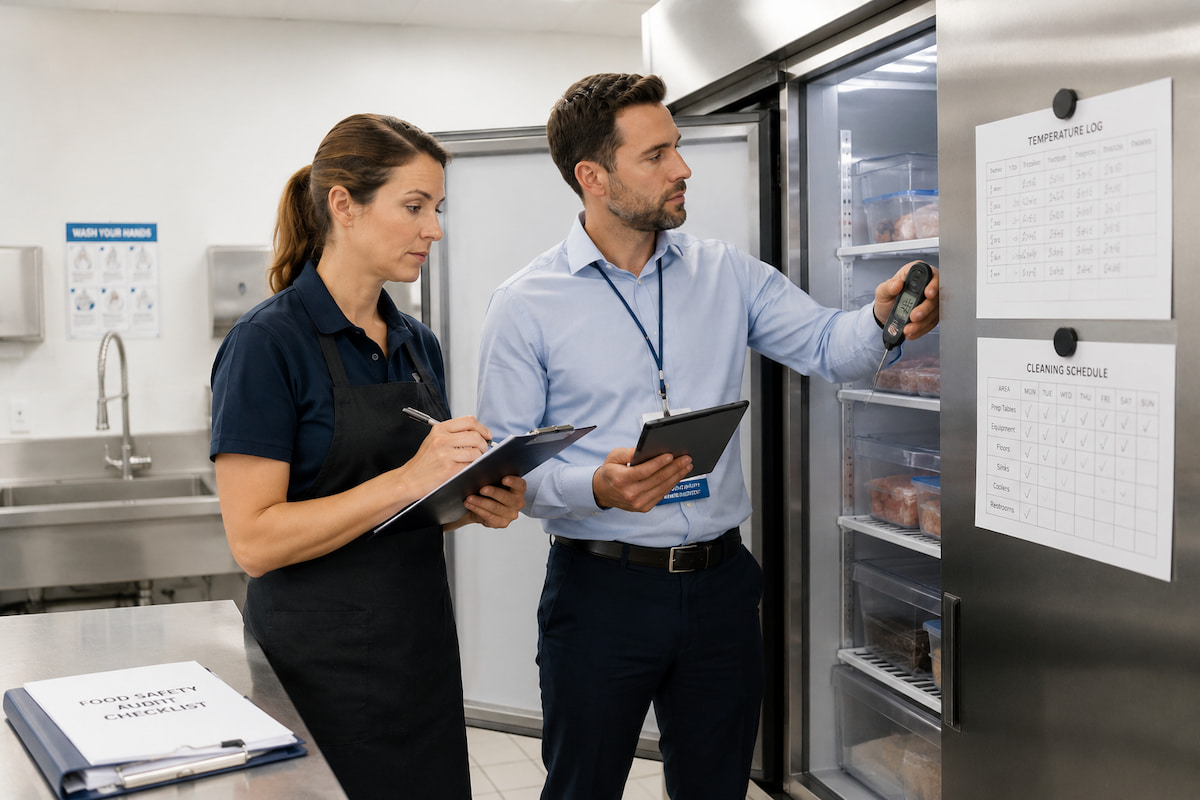
Table of Contents
- What Is a Restaurant Food Safety Audit?
- Why Food Safety Audits Are Important
- Internal vs External Food Safety Audits
- Restaurant Food Safety Audit Checklist
- Common Food Safety Violations
- Corrective Actions
- Preparing for Health Inspections
- Frequently Asked Questions
What Is a Restaurant Food Safety Audit?
A restaurant food safety audit is a systematic evaluation of food handling practices, sanitation procedures, documentation, employee behaviors, facility conditions, and operational controls. Unlike routine inspections, audits are designed to identify weaknesses before they result in violations, complaints, or food safety incidents.
During an audit, every aspect of the operation may be reviewed, including food receiving procedures, storage practices, preparation methods, temperature monitoring systems, cleaning programs, pest control measures, employee training records, and compliance documentation.
The goal is not simply to identify problems. Instead, a food safety audit helps operators understand why issues occur and what actions are necessary to prevent them from happening again.
Consequently, organizations that conduct regular audits are often better prepared for inspections and more successful at maintaining consistent food safety standards.
A health inspection evaluates compliance at a specific moment in time. By contrast, a food safety audit evaluates the effectiveness of the systems that support long-term compliance.
Why Food Safety Audits Are Important
Food safety audits provide significant benefits for restaurants, cafés, bakeries, food trucks, commissary kitchens, and other food businesses. More importantly, they help operators identify risks before those risks affect customers.
Regular auditing supports stronger operational control while improving employee accountability and documentation accuracy. In addition, audits often reveal small issues that can be corrected quickly before they become serious violations.
Benefits of Conducting Food Safety Audits
Consequently, restaurants that conduct routine audits often identify problems earlier and resolve them before they affect customers, employees, or regulators.
- Reduce foodborne illness risks
- Improve regulatory compliance
- Strengthen employee accountability
- Identify training deficiencies
- Improve food handling practices
- Verify sanitation effectiveness
- Reduce operational risks
- Prepare for inspections
- Protect brand reputation
- Support continuous improvement
Furthermore, audits help restaurant owners gain confidence that food safety procedures are being followed consistently across all shifts and departments.
How Audits Support Inspection Readiness
Many operators mistakenly assume that health inspections are the only compliance review they need to prepare for. However, waiting until an inspection is scheduled can leave little time to correct operational deficiencies.
Regular audits provide opportunities to identify documentation gaps, temperature control issues, sanitation weaknesses, and employee training deficiencies before inspectors arrive. As a result, businesses can address problems proactively rather than reactively.
Additionally, audit records demonstrate that management actively monitors food safety performance. This commitment to compliance often contributes to stronger food safety cultures and improved operational outcomes.
For additional guidance, review our Restaurant Health Inspection Checklist BC and Food Safety Plan resources.
Internal vs External Food Safety Audits
Food safety audits generally fall into two categories: internal audits and external audits. While both approaches provide valuable information, each serves a different purpose within a food safety management system.
Internal Food Safety Audits
Internal audits are conducted by restaurant managers, supervisors, owners, or designated food safety personnel. These audits typically occur on a routine basis and focus on identifying opportunities for improvement.
Because internal audits are performed regularly, they allow management teams to monitor trends, evaluate employee performance, and verify that food safety procedures are being followed consistently.
Advantages of Internal Audits
- Lower cost
- More frequent evaluations
- Continuous monitoring
- Improved employee accountability
- Early identification of deficiencies
Furthermore, regular internal audits help management measure progress and verify that previous corrective actions remain effective.
External Food Safety Audits
External audits are conducted by third-party consultants, regulatory agencies, certification bodies, customers, or food safety specialists. These audits provide independent evaluations of compliance and operational performance.
Since external auditors bring an objective perspective, they often identify risks and deficiencies that internal teams may overlook.
Advantages of External Audits
- Independent evaluation
- Objective assessment
- Industry expertise
- Regulatory readiness
- Enhanced credibility
Likewise, external audits provide an independent perspective that can reveal risks internal teams may overlook.
| Internal Audit | External Audit |
|---|---|
| Performed by management or staff | Performed by independent professionals |
| Lower cost | Higher cost |
| Conducted more frequently | Periodic evaluation |
| Focus on continuous improvement | Focus on objective assessment |
| Operational monitoring | Compliance verification |
In many cases, the most effective approach combines routine internal audits with periodic external evaluations. Therefore, restaurants can benefit from both continuous monitoring and independent review.
Restaurant Food Safety Audit Checklist
A comprehensive food safety audit examines every stage of food handling, storage, preparation, service, sanitation, and documentation. While each operation is unique, most audits evaluate the same core areas that directly affect food safety and regulatory compliance.
The following checklist can help restaurant owners, managers, and food safety coordinators evaluate operational performance before an inspection or third-party audit.
Food Receiving Procedures
Food safety begins when products arrive at your facility. Therefore, receiving procedures should verify that food is sourced from approved suppliers and arrives in acceptable condition.
Receiving Audit Checklist
- ☐ Purchase products from approved suppliers
- ☐ Inspect deliveries upon arrival
- ☐ Verify refrigerated products arrive at safe temperatures
- ☐ Verify frozen products remain frozen
- ☐ Inspect packaging for damage
- ☐ Verify expiry dates
- ☐ Document delivery temperatures
- ☐ Record rejected products appropriately
In addition, receiving personnel should understand when products must be rejected and how to document corrective actions when delivery standards are not met.
Food Storage Audit Checklist
Improper storage practices are among the most common causes of food safety violations. Consequently, storage areas should be reviewed regularly to verify organization, temperature control, labeling, and contamination prevention.
Storage Audit Checklist
- ☐ Verify refrigerator temperatures
- ☐ Verify freezer temperatures
- ☐ Calibrate and test thermometers
- ☐ Label food properly
- ☐ Follow date-marking procedures
- ☐ Implement FIFO procedures
- ☐ Separate raw and ready-to-eat foods
- ☐ Store chemicals away from food products
- ☐ Store food off the floor
- ☐ Storage areas remain clean and organized
Furthermore, auditors often verify that storage practices align with the procedures outlined in the facility’s Food Safety Plan.
Food Preparation Audit Checklist
Food preparation activities present significant opportunities for contamination if proper procedures are not followed consistently.
As a result, auditors typically observe employee practices directly rather than relying solely on documentation.
Preparation Audit Checklist
- ☐ Follow handwashing procedures
- ☐ Use gloves appropriately
- ☐ Verify cross-contamination controls/li>
- ☐ Use separate cutting boards when required
- ☐ Sanitize food preparation surfaces
- ☐ Manage allergens properly
- ☐ Follow approved thawing procedures
- ☐ Document ingredient handling procedures
Additionally, auditors often assess whether employees understand the reasons behind food safety procedures and can explain them when questioned.
Cooking and Holding Audit Checklist
Temperature control is one of the most critical food safety controls in any restaurant. Therefore, cooking and holding procedures receive significant attention during audits.
Cooking & Holding Checklist
- ☐ Monitor cooking temperatures
- ☐ Maintain temperature logs
- ☐ Calibrate probe thermometers
- ☐ Verify hot holding temperatures
- ☐ Verify cold holding temperatures
- ☐ Document cooling procedures
- ☐ Follow reheating procedures
- ☐ Document corrective actions when limits are exceeded
Temperature records should not simply exist. Auditors also verify that employees review records regularly and take corrective action whenever food safety limits are exceeded.
Cleaning and Sanitation Audit Checklist
Cleaning and sanitation programs help control bacteria, allergens, pests, and contamination risks throughout the operation.
Because sanitation affects every department, auditors often review both documentation and physical conditions during evaluations.
Sanitation Audit Checklist
- ☐ Document cleaning schedules
- ☐ Cleaning tasks are completed as scheduled
- ☐ Verify sanitizer concentrations
- ☐ Test strips are available and used correctly
- ☐ Food-contact surfaces are sanitized properly
- ☐ Dishwashing procedures are effective
- ☐ Maintain waste management systems
- ☐ Facility cleanliness meets standards
Restaurants should also maintain a documented Sanitation Plan outlining cleaning frequencies, responsibilities, verification procedures, and corrective actions.
Employee Food Safety Practices
Employee behavior often determines whether food safety systems succeed or fail. Consequently, auditors evaluate employee knowledge, training, and day-to-day practices throughout the audit process.
Employee Audit Checklist
- ☐ Management verifies FoodSafe certifications remain current
- ☐ Follow personal hygiene standards/li>
- ☐ Train staff on illness reporting procedures
- ☐ Employees understand food safety responsibilities
- ☐ Maintain uniform standards/li>
- ☐ Use hair restraints where required
- ☐ Document ongoing food safety training
- ☐ Supervisors actively monitor compliance
Moreover, employee interviews often reveal training gaps that may not be obvious from documentation alone.
Documentation and Record-Keeping Audit Checklist
Documentation provides evidence that food safety systems are operating effectively. Without proper records, it can be difficult to demonstrate compliance even when procedures are being followed correctly.
Documentation Checklist
- ☐ Keep the Food Safety Plan current/li>
- ☐ Keep the Sanitation Plan current
- ☐ Complete temperature logs
- ☐ Corrective action records are maintained
- ☐ Maintain pest control records
- ☐ Keep employee training records current
- ☐ Organize equipment maintenance records
- ☐ Retain audit reports for review
Ultimately, documentation demonstrates that food safety procedures are not only developed but actively implemented throughout the operation.
In the next section, we will examine the most common food safety violations discovered during restaurant audits and explain how corrective actions can prevent those deficiencies from recurring.
Therefore, maintaining accurate records supports compliance while demonstrating that food safety controls operate effectively every day.
Common Food Safety Violations Found During Audits
Even well-managed restaurants occasionally discover deficiencies during food safety audits. However, identifying these issues internally is far preferable to having them discovered during a health inspection.
Most violations are not caused by a lack of effort. Instead, they often result from inconsistent procedures, inadequate training, poor documentation, or insufficient monitoring systems.
Why Restaurants Repeat the Same Food Safety Mistakes
In many cases, recurring violations do not result from a lack of knowledge. Instead, employees may follow procedures inconsistently, managers may overlook verification activities, or documentation systems may break down over time. Consequently, restaurants should investigate recurring issues carefully and address their underlying causes rather than only correcting the visible symptoms.
Most Common Audit Findings
- Improper food storage practices
- Missing temperature records
- Inadequate handwashing procedures
- Cross-contamination risks
- Improper cooling procedures
- Incomplete sanitation documentation
- Missing employee training records
- Expired food products
- Improper chemical storage
- Missing corrective action documentation
Furthermore, recurring violations often indicate that procedures exist on paper but are not being followed consistently during daily operations.
Meanwhile, management should analyze recurring violations carefully because repeated findings often indicate deeper operational weaknesses.
How to Implement Corrective Actions
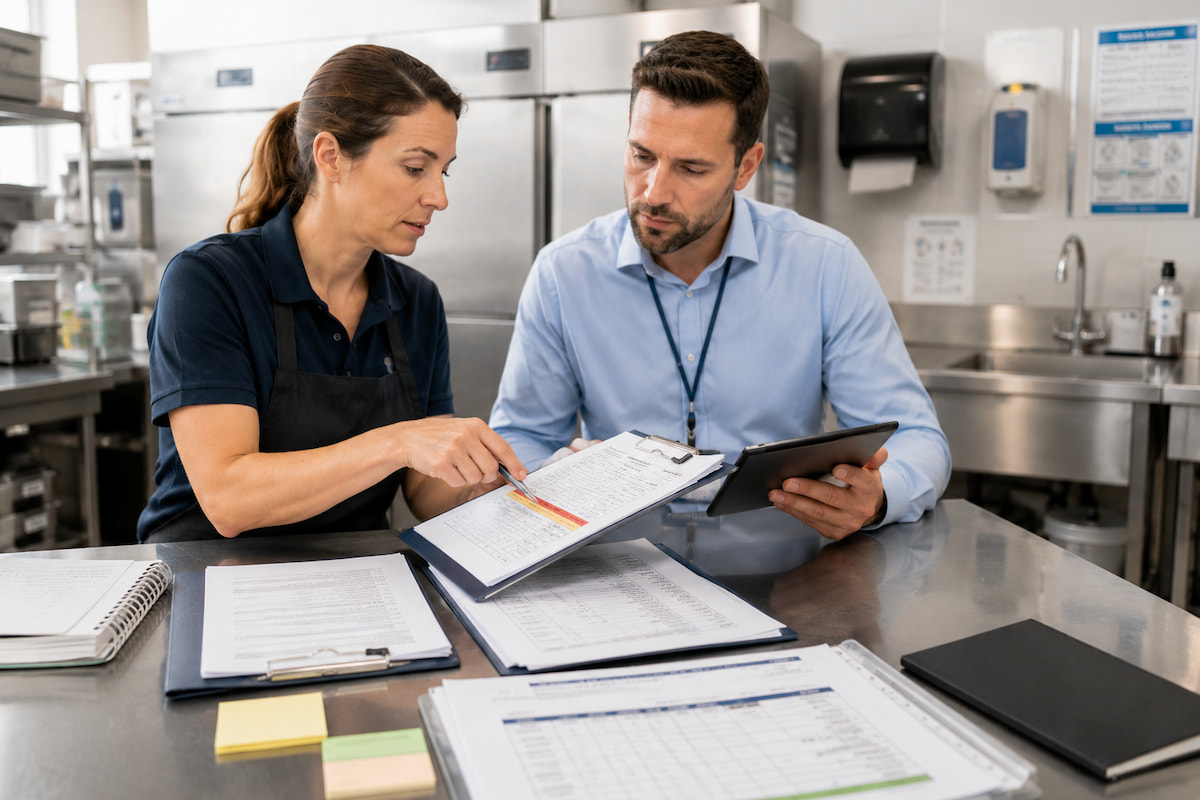
Identifying deficiencies is only the first step. More importantly, operators must implement corrective actions that address the root cause of each issue.
Consequently, effective corrective actions focus on prevention rather than simply fixing the immediate problem.
In some cases, corrective actions involve more than updating procedures or retraining staff. For example, poor kitchen layouts, cross-contamination risks, and inefficient workflows may require operational redesign. Our Kitchen Workflow & Food Safety Floor Plan Consulting service helps restaurants improve food safety, efficiency, and compliance through better facility design.
Building Effective Corrective Action Plans
| Audit Finding | Corrective Action |
|---|---|
| Missing temperature logs | Retrain staff and implement daily verification procedures |
| Improper food storage | Reorganize storage systems and reinforce labeling standards |
| Sanitation deficiencies | Update cleaning schedules and increase supervision |
| Training gaps | Conduct refresher training and document competency reviews |
| Cross-contamination risks | Review workflows and strengthen food handling procedures |
In addition, all corrective actions should be documented so that future audits can verify that deficiencies have been addressed successfully.
As a result, documented corrective actions create accountability and help prevent the same deficiencies from recurring in future audits.
Preparing for a Health Inspection
Restaurants that perform regular food safety audits are generally better prepared for health inspections. As a result, inspections often proceed more smoothly and with fewer corrective actions required.
Nevertheless, operators should conduct a final review before an inspector arrives.
Pre-Inspection Review Checklist
- ☐ Verify all documentation is complete
- ☐ Review temperature logs
- ☐ Confirm employee certifications
- ☐ Inspect refrigeration systems
- ☐ Verify sanitizer concentrations
- ☐ Review cleaning records
- ☐ Conduct a facility walkthrough
- ☐ Correct any identified deficiencies
For additional guidance, review our Restaurant Health Inspection Checklist BC before scheduling your inspection.
Case Study: Preventing Inspection Delays Through Auditing
A newly opened food service operation requested assistance several weeks before its scheduled inspection. Although construction had been completed successfully, the management team was unsure whether its food safety systems met regulatory expectations.
After conducting a comprehensive food safety audit, the audit team identified several deficiencies, including incomplete temperature logs, inconsistent sanitation documentation, and gaps in employee training records.
Subsequently, management implemented corrective actions, improved documentation systems, and provided additional staff training. As a result, the operation entered its inspection fully prepared and avoided delays that could have postponed opening.
Lessons Learned from This Audit
The restaurant successfully addressed all identified deficiencies before inspection, improving compliance readiness while reducing operational risk.
Long-Term Benefits of Food Safety Audits
Why Regular Food Safety Audits Matter
Food safety audits should not be viewed solely as compliance exercises. Instead, they serve as valuable management tools that help protect customers, employees, and the business itself.
Moreover, regular audits promote accountability, improve operational consistency, strengthen employee training, and reduce the likelihood of costly violations.
Ultimately, restaurants that perform routine audits are often better positioned to maintain compliance, improve food safety culture, and achieve long-term operational success.
Need Help Conducting a Restaurant Food Safety Audit?
Chef Eric helps restaurants, cafés, bakeries, food trucks, commissary kitchens, and hospitality operations develop Food Safety Plans, Sanitation Programs, Audit Systems, Employee Training Programs, and Health Inspection Readiness Procedures.
For restaurants seeking hands-on support, explore our Restaurant Consulting Vancouver services for food safety systems, operational audits, staff training, and compliance support.
Whether you need a complete food safety audit, compliance review, corrective action plan, or staff training program, professional guidance can help reduce risk, improve compliance, and strengthen food safety performance.
Phone: (604) 781-9557
Email: info@911cheferic.com
What is a restaurant food safety audit?
A restaurant food safety audit is a systematic review of food handling procedures, sanitation programs, employee practices, documentation, and operational controls. In addition, the audit helps identify food safety risks before they become violations, customer complaints, or inspection issues.
Frequently Asked Questions
What should restaurants do after completing a food safety audit?
After completing a food safety audit, management should review all findings and prioritize corrective actions. In addition, supervisors should assign responsibilities and establish implementation deadlines. Once improvements are completed, managers should verify their effectiveness. As a result, the operation can maintain stronger food safety controls and reduce future compliance risks.
Can food safety audits improve employee performance?
Yes. Food safety audits help employees understand expectations and identify opportunities for improvement. Furthermore, audits reinforce accountability and encourage consistent food handling practices. Consequently, many restaurants experience stronger compliance, improved teamwork, and better operational performance.
Are food safety audits required by law?
Health regulations generally require restaurants to maintain safe food handling practices and compliance systems. However, regulations do not always require formal internal audits. Nevertheless, many operators conduct routine audits because they help identify risks early. As a result, businesses can often prevent violations before they occur.
How often should restaurants conduct food safety audits?
Many restaurants perform internal audits monthly or quarterly. However, higher-risk operations may benefit from more frequent reviews. In addition, businesses that handle large volumes of food often require closer monitoring. Therefore, audit frequency should reflect the complexity of the operation.
What is the difference between an internal and external food safety audit?
Internal audits are conducted by restaurant managers, supervisors, or designated team members. By contrast, external audits are performed by consultants, certification bodies, customers, or regulatory agencies. Consequently, external audits often provide a more objective perspective. Furthermore, they may identify risks that internal teams overlook.
What are the most common food safety violations?
Common violations include improper food storage, inadequate handwashing, missing temperature records, sanitation deficiencies, and cross-contamination risks. In addition, incomplete documentation frequently appears during inspections and audits. Therefore, operators should monitor these areas consistently. Otherwise, minor issues can quickly become significant compliance concerns.
How can I prepare for a health inspection?
Conduct a comprehensive food safety audit before the inspection occurs. In addition, review documentation, verify employee training, inspect equipment, and correct any deficiencies. Furthermore, perform a final walkthrough to confirm that procedures are being followed consistently. As a result, your team will be better prepared when inspectors arrive.
Who should conduct a food safety audit?
Restaurant managers, supervisors, food safety coordinators, and qualified consultants can conduct food safety audits. However, many businesses also use external auditors because they provide an independent perspective. In addition, external specialists often bring industry experience from multiple operations. Consequently, they may identify improvement opportunities more quickly.
Can food safety audits reduce the risk of health inspection violations?
Yes. Regular audits help identify deficiencies before inspectors discover them. As a result, restaurants can implement corrective actions sooner and strengthen compliance systems. Furthermore, audits help reinforce employee accountability and operational consistency. Therefore, businesses often experience fewer inspection-related surprises.
Why is documentation important during a food safety audit?
Documentation provides evidence that food safety procedures are being followed consistently. Moreover, complete records help demonstrate compliance and support corrective actions. In addition, documentation allows managers to track trends and verify improvements over time. Consequently, strong record-keeping strengthens both compliance and operational control.