
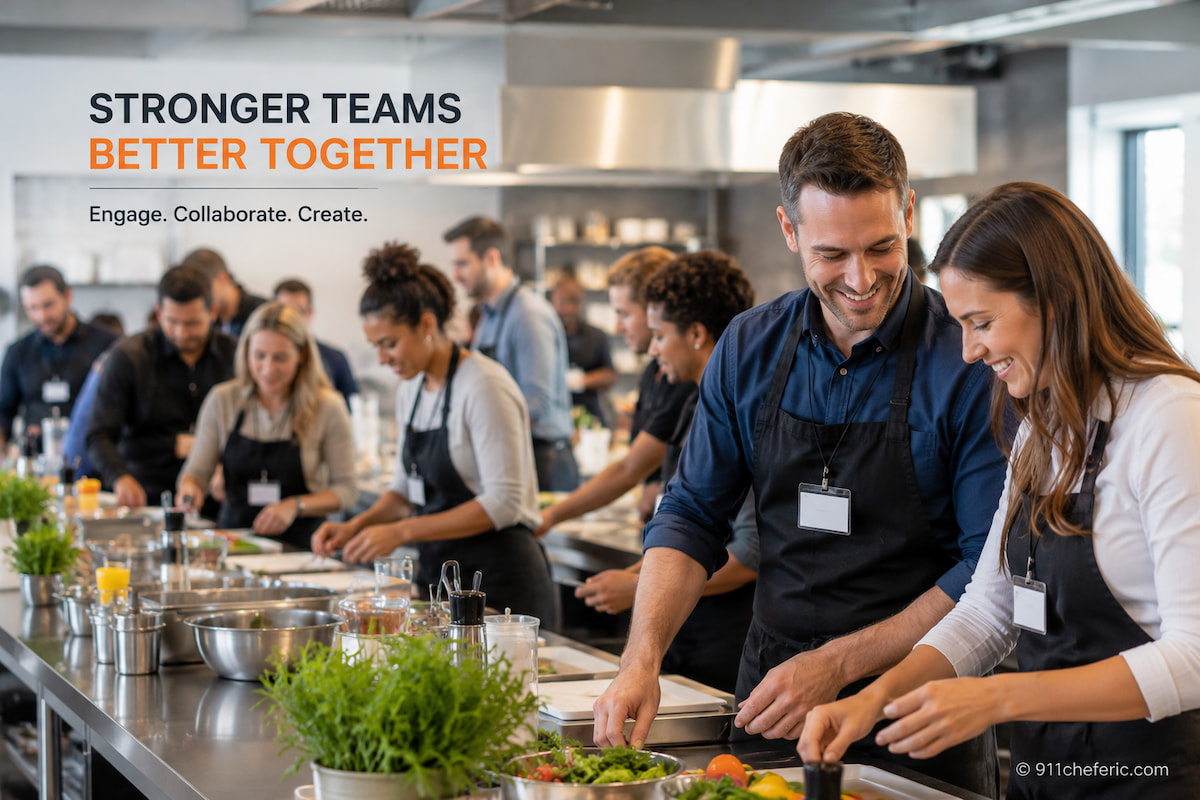
Cooking Events for Employee Engagement
Employee engagement has become one of the most important drivers of workplace performance, retention, and organizational success. Companies that invest in meaningful employee experiences often see stronger collaboration, higher morale, improved communication, and lower turnover. Among the many engagement initiatives available today, corporate cooking events stand out because they combine teamwork, creativity, problem solving, and shared achievement into one memorable experience.
Table of Contents
- Why Employee Engagement Matters
- The Cost of Employee Disengagement
- Why Cooking Events Work
- 7 Benefits of Cooking Events for Employee Engagement
- How Cooking Events Strengthen Workplace Culture
- Employee Retention and Engagement
- Cooking Events for Hybrid and Remote Teams
- Related Resources
- Frequently Asked Questions
Why Employee Engagement Matters
Employee engagement is far more than job satisfaction. Engaged employees feel connected to their work, aligned with organizational goals, and motivated to contribute to team success. They are more likely to collaborate effectively, support colleagues, take initiative, and remain committed to the organization.
Organizations with highly engaged employees often experience stronger productivity, better customer experiences, improved workplace culture, and reduced turnover. Engagement influences nearly every aspect of business performance because people perform differently when they feel valued, connected, and involved.
Unfortunately, many organizations focus heavily on operational performance while overlooking the employee experience. When engagement declines, morale often follows. Productivity decreases, communication suffers, and workplace culture becomes more difficult to maintain.
Employee engagement is not created through policies alone. It develops through positive experiences, meaningful interactions, recognition, communication, and a sense of belonging.
The Cost of Employee Disengagement
Many organizations underestimate the financial and cultural impact of disengagement. When employees feel disconnected from their team or workplace, performance often declines gradually rather than suddenly. Managers may notice reduced enthusiasm, lower participation in meetings, weaker collaboration, and a general decline in initiative.
Disengagement can lead to:
- Higher employee turnover
- Increased absenteeism
- Reduced productivity
- Poor communication
- Lower workplace morale
- Inconsistent customer experiences
- Reduced innovation and creativity
These challenges become even more significant in organizations with hybrid teams, multiple departments, or rapid growth. As teams expand, maintaining meaningful employee connections becomes more difficult. This is why many organizations actively invest in employee engagement initiatives that strengthen relationships and create shared experiences.
Why Cooking Events Work Better Than Many Traditional Engagement Activities
Many employee engagement initiatives provide temporary entertainment but fail to create lasting impact. Employees may enjoy a social event, but the positive effects often disappear within days. The most effective engagement activities create opportunities for meaningful interaction while encouraging collaboration, communication, and shared achievement.
Cooking events naturally accomplish all of these objectives. Organizations looking for structured culinary team building experiences often choose cooking programs because they combine communication, collaboration, problem-solving, and shared achievement in a single activity.
Unlike passive entertainment, cooking requires participation. Team members must work together, coordinate tasks, communicate effectively, solve problems, and support one another to achieve a common goal. The process creates genuine interaction rather than forced conversation.
Cooking also places participants in a completely different environment than their normal workplace. Job titles become less important. Employees interact as teammates rather than departments or organizational levels. This creates stronger personal connections and helps break down workplace barriers.
Most importantly, participants enjoy an immediate and rewarding outcome. At the end of the experience, everyone shares a meal they helped create together. This sense of accomplishment reinforces teamwork and strengthens engagement in a way few traditional activities can match.
7 Benefits of Cooking Events for Employee Engagement
1. Improves Team Communication
Successful cooking depends on communication. Participants must share information, coordinate timing, discuss priorities, and adapt throughout the experience. These interactions occur naturally because they are necessary to achieve the final result.
2. Encourages Collaboration
Cooking challenges cannot be completed effectively by one individual alone. Teams must work together, delegate responsibilities, and support one another throughout the process.
3. Builds Stronger Workplace Relationships
Employees often interact differently outside their normal work environment. Cooking events provide opportunities for colleagues to connect in a more personal and authentic way.
4. Increases Employee Morale
Employees appreciate experiences that are engaging, rewarding, and enjoyable. Cooking events provide a positive shared experience that contributes directly to morale and workplace satisfaction.
5. Supports Leadership Development
Leadership often emerges naturally during cooking activities. Some participants take initiative, organize tasks, and help coordinate the group. These experiences can reveal leadership potential that may not be visible during regular workplace interactions.
6. Strengthens Workplace Culture
Workplace culture is shaped by the daily interactions employees have with one another. While policies, mission statements, and company values provide direction, culture ultimately develops through shared experiences and relationships.
Cooking events create opportunities for employees to work together in a positive and supportive environment. Participants learn to communicate more effectively, solve problems collaboratively, and celebrate shared successes. These experiences contribute to stronger interpersonal relationships that carry back into the workplace.
Organizations that prioritize employee engagement often discover that culture improves naturally when employees feel connected to one another. Rather than relying solely on formal initiatives, cooking events help strengthen culture through genuine interaction and teamwork.
7. Creates Lasting Memories and Shared Experiences
Many employee engagement activities are quickly forgotten after the event ends. Cooking experiences tend to have a much longer impact because employees actively participate in creating something together.
The experience often becomes a shared story within the organization. Employees remember the challenges they solved, the dishes they prepared, and the conversations they shared. These positive memories strengthen relationships and contribute to a stronger sense of belonging.
When employees look back on meaningful workplace experiences, they are more likely to associate those experiences with positive feelings about their team and organization.
Employee Engagement and Workplace Performance
Employee engagement directly influences organizational performance. Engaged employees are generally more motivated, more productive, and more willing to contribute beyond the minimum expectations of their role.
While engagement is often discussed from a human resources perspective, it also has significant business implications. Strong engagement can contribute to improved customer experiences, stronger teamwork, higher productivity, and better employee retention.
| Engaged Employees | Disengaged Employees |
|---|---|
| Actively participate in team initiatives | Limit participation whenever possible |
| Support colleagues and collaboration | Work in isolation |
| Take ownership of responsibilities | Focus only on assigned tasks |
| Contribute ideas and solutions | Avoid additional involvement |
| Remain committed to organizational goals | Feel disconnected from company objectives |
While no single event can completely transform workplace culture, employee engagement activities that create authentic connections often have a meaningful and lasting impact.
How Cooking Events Strengthen Workplace Culture
Strong workplace cultures are built through trust, communication, recognition, and shared experiences. Employees who feel connected to their colleagues are more likely to collaborate effectively and contribute positively to the workplace environment.
Cooking events support these outcomes because they encourage participation from everyone involved. Well-designed team building cooking classes in Vancouver help employees connect outside their normal work environment while strengthening workplace relationships.
Unlike many traditional corporate gatherings where employees spend most of their time observing, cooking requires engagement from start to finish. Team members share responsibilities, solve problems together, and celebrate accomplishments as a group.
The strongest workplace cultures are created when employees feel valued, connected, and involved. Cooking events create opportunities for all three.
Employee Recognition and Appreciation Through Shared Experiences
Recognition is a critical component of employee engagement. Employees want to know that their contributions are valued and appreciated.
Many organizations use cooking events as part of their employee appreciation strategy because they provide something more meaningful than a standard reward or gift. Rather than simply receiving recognition, employees participate in an experience designed to celebrate their contributions and strengthen team relationships.
Cooking events are commonly used for:
- Employee appreciation initiatives
- Holiday celebrations
- Sales achievement recognition
- Project completion celebrations
- Leadership retreats
- Company anniversaries
- Department milestones
- Staff appreciation events
These experiences often generate stronger engagement because they create positive memories while reinforcing the organization’s commitment to its employees.
Employee Retention and Engagement
Employee retention remains one of the most significant challenges facing organizations across many industries. Recruiting, onboarding, and training new employees requires substantial time and resources. Retaining experienced team members is often far more cost-effective than replacing them.
While compensation and benefits play an important role, employees are also influenced by workplace culture, leadership, recognition, and relationships with colleagues.
Organizations that invest in employee engagement often experience stronger retention because employees feel more connected to the workplace. When individuals feel appreciated, included, and supported, they are more likely to remain committed to the organization.
Cooking events contribute to retention by strengthening relationships, improving morale, and creating positive experiences that employees associate with the company.
Cooking Events for Hybrid and Remote Teams
Employee engagement becomes more challenging when teams are distributed across multiple locations. While virtual meetings help organizations maintain communication, they rarely create the same level of connection that employees experience through shared activities.
Hybrid and remote work environments have increased flexibility for many organizations, but they have also reduced opportunities for spontaneous interaction. Employees may spend weeks communicating exclusively through video calls, emails, and messaging platforms without developing meaningful personal relationships.
Cooking events provide an effective solution because they allow employees to participate in a shared experience regardless of location.
Through live virtual cooking classes, team members can prepare the same menu simultaneously while interacting in real time. This creates opportunities for conversation, collaboration, and engagement that extend beyond traditional online meetings.
Organizations throughout British Columbia can also take advantage of ingredient delivery solutions that allow participants to receive identical ingredients before the event. This ensures a consistent experience while making participation simple and convenient.
Whether employees are located in Vancouver, Victoria, Kelowna, Nanaimo, Kamloops, Prince George, or elsewhere throughout the province, everyone can participate together and enjoy the same culinary experience.
Looking for a Unique Employee Engagement Activity?
Our corporate cooking experiences are designed to improve communication, strengthen workplace culture, encourage collaboration, and create memorable shared experiences for teams of all sizes.
Choosing the Right Employee Engagement Activity
Not all employee engagement initiatives deliver the same results. The most effective activities create opportunities for participation, interaction, and meaningful connection.
When evaluating engagement activities, organizations should consider several factors:
- Does the activity encourage participation from everyone?
- Does it create opportunities for genuine interaction?
- Can employees of different skill levels participate comfortably?
- Will the experience support communication and collaboration?
- Does it align with company culture and organizational objectives?
- Will employees remember the experience after it ends?
Cooking events consistently perform well across all of these criteria because they combine practical teamwork with a rewarding and enjoyable outcome.
Rather than focusing solely on entertainment, participants actively contribute throughout the experience. The result is stronger engagement and a greater sense of connection among team members.
Why Vancouver Companies Are Investing in Employee Engagement
Competition for talent continues to increase across many industries. Organizations are recognizing that employee engagement is no longer simply a human resources initiative; it is a business strategy.
Companies that invest in engagement often experience benefits that extend far beyond employee satisfaction. Improved communication, stronger teamwork, enhanced workplace culture, and better retention can all contribute to long-term organizational performance.
As a result, more Vancouver companies are incorporating experiential learning and team-building activities into their employee development strategies. Corporate cooking events provide a practical and engaging way to support these objectives while creating memorable experiences employees genuinely enjoy.
Looking for a Unique Executive Retreat or Team Experience?
While corporate cooking classes provide an excellent local team-building experience, some organizations choose to invest in larger-scale leadership retreats, executive rewards, and immersive team experiences.
Chef Eric also leads curated culinary travel experiences in France, combining food, culture, hospitality, and unforgettable shared experiences. These programs can be ideal for leadership teams, top performers, client appreciation initiatives, and organizations seeking a truly memorable team experience beyond the traditional corporate event.
From exploring local markets and regional cuisine to experiencing French food culture firsthand, culinary travel creates meaningful connections that often extend far beyond the trip itself.
Related Resources
Team Building Cooking Classes
Interactive culinary experiences designed to improve communication, collaboration, leadership, and workplace engagement.
Corporate Cooking Classes
Custom culinary experiences for employee appreciation, corporate events, leadership retreats, and team development.
Contact Chef Eric
Discuss your goals and create a customized employee engagement experience for your team.
Final Thoughts
Employee engagement is one of the strongest predictors of workplace performance, employee retention, and organizational success. While engagement cannot be created through policies alone, meaningful experiences can play a significant role in strengthening workplace relationships and building a positive culture.
Cooking events provide a unique opportunity for employees to communicate, collaborate, solve problems, and celebrate shared accomplishments together. These experiences help create stronger connections while supporting many of the workplace qualities organizations value most.
Whether your goal is to improve morale, strengthen workplace culture, reward employees, encourage collaboration, or support long-term retention, a corporate cooking event can be an effective and memorable solution.
Ready to Improve Employee Engagement?
Discover how a customized cooking experience can help your team strengthen communication, collaboration, morale, and workplace culture.
Frequently Asked Questions
How do cooking events improve employee engagement?
Cooking events encourage participation, communication, collaboration, and shared achievement, helping employees feel more connected to their team and workplace.
Why are cooking events effective team-building activities?
Cooking naturally requires teamwork, communication, planning, problem solving, and adaptability, making it one of the most practical team-building experiences available.
Can cooking events improve workplace culture?
Yes. Shared experiences help strengthen relationships, improve communication, and create positive memories that contribute to a stronger workplace culture.
Are corporate cooking events suitable for remote teams?
Absolutely. Virtual cooking experiences allow remote and hybrid employees to participate together regardless of location.
Do employees need cooking experience?
No. Corporate cooking events are designed for participants of all skill levels and focus on teamwork and engagement rather than culinary expertise.
What types of companies benefit from corporate cooking events?
Organizations of all sizes can benefit, including corporate offices, professional service firms, technology companies, healthcare organizations, hospitality businesses, and non-profit organizations.