
Restaurant Systems and Operations: Prime Cost Control
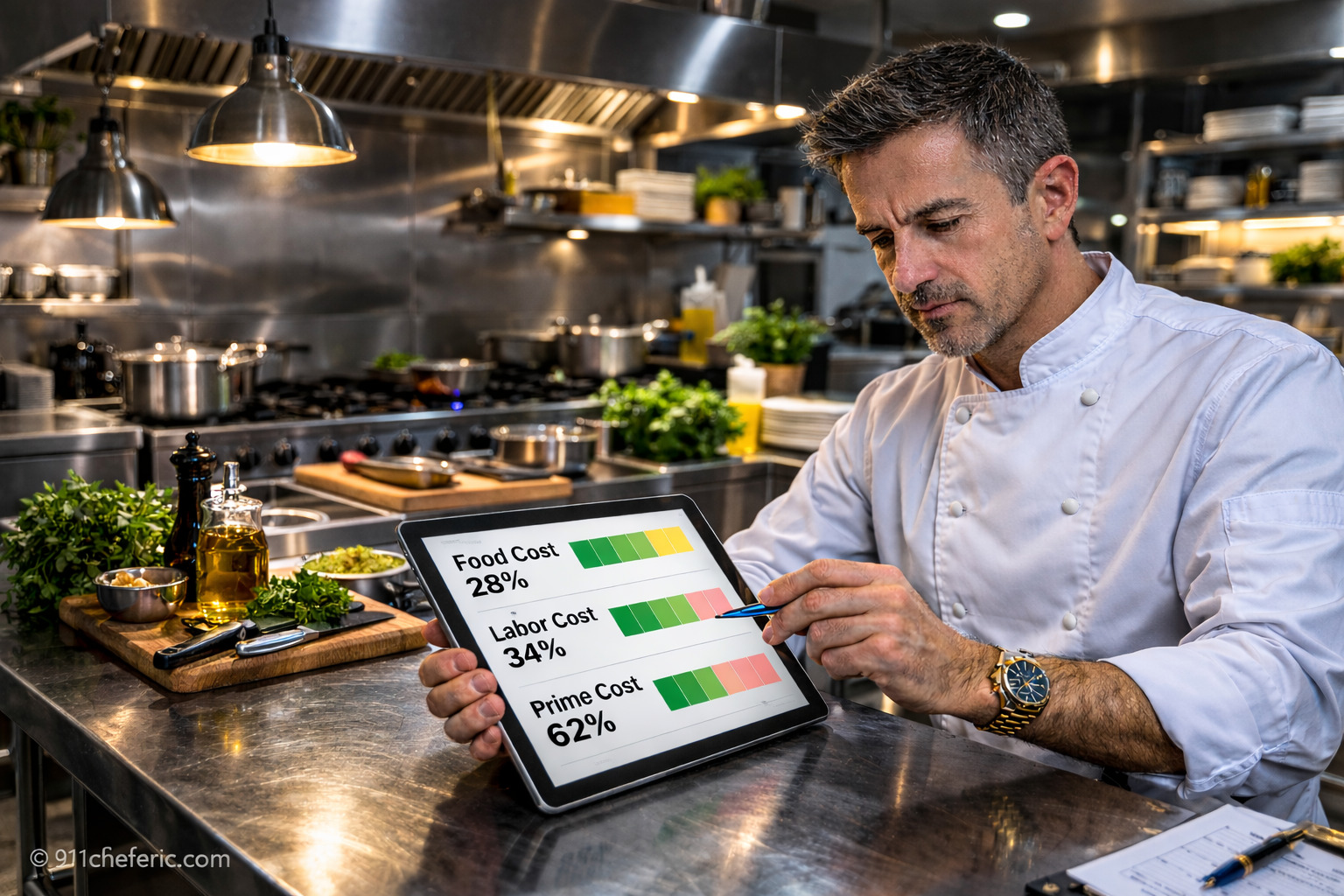
Restaurant systems and operations must focus on one objective: controlling prime cost. Without a structured connection between food cost, labor, and revenue, profitability quickly becomes unstable, even when sales remain strong.
Although the formula itself is simple, effective control requires disciplined systems and consistent execution. In reality, understanding the numbers alone is not enough; operators must actively manage them every day.
Rather than acting as a passive metric, prime cost directly drives operational decisions. While some operators review it monthly, others monitor it continuously and maintain control. Consequently, the gap between reacting and controlling becomes significant.
For a deeper breakdown, refer to the restaurant prime cost control guide as well as the restaurant cost control and profitability system.
Why Restaurants Fail to Control Prime Cost
In practice, most restaurants do not fail because of effort. Instead, problems emerge when systems remain disconnected and decisions become reactive rather than structured.
For example, when forecasting is missing, staffing and production fluctuate unpredictably. At the same time, when schedules rely on availability instead of demand, labor costs rise without improving performance.
| Cause | Operational Breakdown | Financial Impact |
|---|---|---|
| No forecasting system | Unstructured staffing and prep | Uncontrolled labor and food cost |
| Scheduling by availability | Overstaffing | Labor cost inflation |
| No recipe costing | Inaccurate menu margins | Hidden profit loss |
| No waste tracking | Spoilage and overproduction | Food cost increase |
| Monthly reporting only | Delayed visibility | Late corrective action |
In addition, waste directly impacts profitability. Over time, small inefficiencies such as portion drift, trim loss, and overproduction accumulate and reduce margins. As a result, when operators fail to track and correct these issues, prime cost gradually increases.
What a Real Prime Cost Control System Looks Like
A structured system does not rely on isolated actions. Instead, it connects multiple operational layers that reinforce each other. As a result, consistency and control improve significantly.
| System Layer | Role | Impact |
|---|---|---|
| Sales Forecasting | Defines demand | Controls labor and production |
| Labor Scheduling | Aligns staffing | Prevents overstaffing |
| SPLH | Measures productivity | Controls labor efficiency |
| Recipe Costing | Tracks food cost | Protects margins |
| Weekly Tracking | Monitors performance | Enables correction |
If one part of the system is missing, the entire operation becomes unstable. — Chef Eric
Labor Control: Scheduling and SPLH
SPLH stands for Sales Per Labor Hour. More importantly, it connects labor cost directly to revenue and provides a real-time control mechanism.
When SPLH drops, labor costs exceed operational needs. Conversely, when performance improves, efficiency increases. Therefore, operators adjust staffing levels during service instead of reacting afterward.
For full implementation, refer to the restaurant labor scheduling strategy.
Food Cost Control and Waste Reduction
Food cost control must remain operational. Rather than relying on periodic reviews, operators manage costs continuously through structured systems.
For instance, a proper system connects purchasing, recipes, and menu pricing in real time. As ingredient costs change, recipes update accordingly, ensuring accuracy and consistency.
Meanwhile, teams must track waste actively. This includes spoilage, overproduction, and portion inconsistency. Once identified, these issues can be corrected through production planning and standardized execution.
Moreover, structured tools such as live recipe costing systems allow operators to respond immediately. As a result, cost fluctuations no longer go unnoticed.
Related system: restaurant menu engineering
Weekly Prime Cost Tracking
To maintain control, operators must review prime cost weekly. Otherwise, delayed analysis reduces the ability to act quickly and effectively.
| Status | Meaning | Action |
|---|---|---|
| Green | On target | Maintain |
| Orange | Deviation | Investigate immediately |
| Red | Loss | Correct immediately |
This system transforms financial data into operational decisions. — Chef Eric
What Is the Correct Prime Cost?
| Region | Quick Service | Casual Dining | Full Service |
|---|---|---|---|
| North America | 50% – 60% | 55% – 65% | 60% – 70% |
| Europe | 50% – 60% | 55% – 70% | 60% – 75% |
| Asia | 45% – 55% | 50% – 65% | 55% – 70% |
Although these ranges provide guidance, they do not define your target. Instead, your actual prime cost depends on rent, tax structure, labor model, and required profit margin.
For example, higher occupancy costs require tighter control, whereas lower fixed costs allow more flexibility. Therefore, operators must align prime cost with their financial structure.
Prime cost is not a target — it is the result of your system and your cost structure. — Chef Eric
Frequently Asked Questions
What is prime cost in restaurant operations?
Prime cost combines food and labor cost and represents the main profitability driver.
What is a good prime cost percentage?
Most restaurants operate between 50% and 70%, depending on concept and cost structure.
How do you reduce prime cost?
Operators reduce prime cost by improving labor efficiency, controlling food cost, reducing waste, and aligning operations with forecasts.
Get Practical Restaurant Systems Insights
Learn how to control prime cost and build structured restaurant systems.
Need help implementing your system?
Book a Free Consultation