
Restaurant Sales Forecasting System
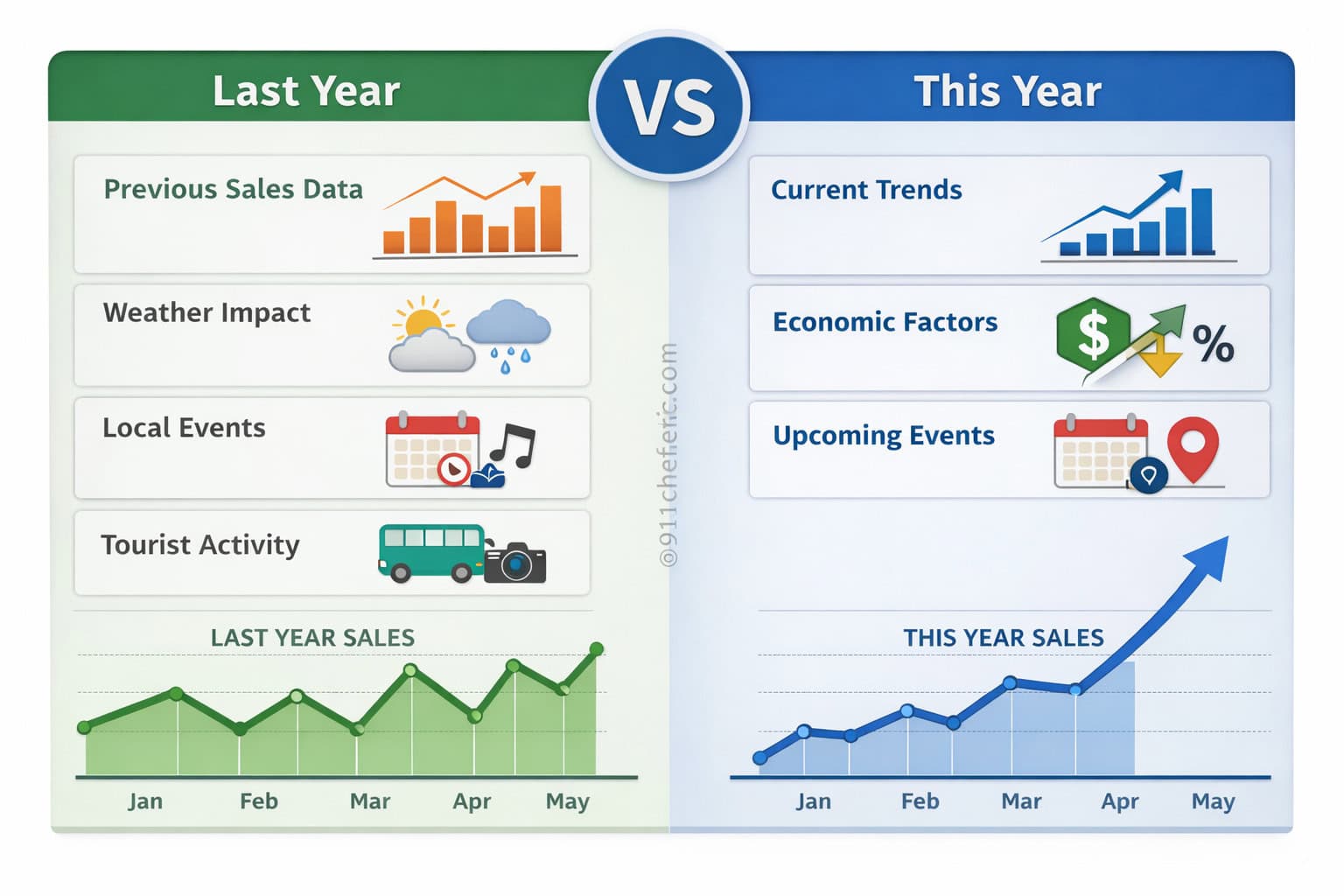
Restaurant sales forecasting system showing how historical data and current market factors influence revenue trends and operational decisions.
Restaurant sales forecasting system implementation is the starting point of operational control. Without it, labor, purchasing, and marketing decisions become reactive, which ultimately destabilizes prime cost.
Although many operators review past sales, very few build a structured forecasting process. As a result, decisions rely on fragmented data instead of controlled inputs. Over time, this creates inconsistency across scheduling, inventory, and profitability.
Therefore, forecasting is not just about predicting revenue. Instead, it connects every operational decision into one controlled system.
Many operators understand the importance of forecasting but struggle to implement reliable systems. Working with a restaurant consultant in Vancouver BC can help establish forecasting models, labor planning systems, inventory controls, and profitability frameworks that improve operational decision-making.
For a full financial framework, refer to the restaurant cost control and profitability system.
Why Restaurants Fail at Sales Forecasting
Most failures come from incomplete data usage rather than lack of effort. In many cases, operators review recent sales but overlook patterns, context, and external variables.
For example, relying only on last week’s numbers removes seasonality and trend visibility. Meanwhile, ignoring historical comparisons eliminates the ability to anticipate demand shifts.
| Cause | Operational Breakdown | Financial Impact |
|---|---|---|
| No structured system | Reactive decisions | Unstable margins |
| Limited data use | Missed trends | Inconsistent revenue planning |
| No external analysis | Blind forecasting | Operational mismatch |
| No review process | No correction loop | Compounding errors |
As these gaps accumulate, forecasting accuracy declines. Consequently, labor, purchasing, and marketing drift out of alignment.
How Real Operators Build a Forecast
In practice, forecasting combines historical data, current conditions, and forward-looking indicators. Rather than relying on a single source, operators build a layered view of demand.
To begin with, historical data from POS and accounting systems provides the baseline. Over time, this reveals patterns such as peak days, slow periods, and seasonal fluctuations.
Next, recent performance should be compared with previous periods. For instance, reviewing last month or the same period last year allows operators to identify growth, decline, or stability.
In addition, external factors must be integrated. This includes weather forecasts, local events, holidays, and tourism activity. Moreover, broader economic conditions influence customer behavior, especially in regions driven by tourism or discretionary spending.
At the same time, internal drivers also matter. Promotions, menu changes, and marketing campaigns directly impact demand and must be considered.
Finally, all inputs are combined into a structured forecast. As a result, operators create a realistic projection that reflects both historical performance and current conditions.
What a Real Sales Forecasting System Looks Like
A proper system connects multiple layers rather than relying on isolated estimates. As a result, forecasting becomes consistent and actionable.
| System Layer | Role | Impact |
|---|---|---|
| Historical Data | Baseline performance | Pattern recognition |
| Comparative Analysis | Trend validation | Improved accuracy |
| External Factors | Market context | Refined projections |
| Internal Drivers | Operational influence | Demand control |
| Weekly Review | Performance correction | System stability |
Forecasting is not a guess. Instead, it is a structured interpretation of data. — Chef Eric
How Forecasting Drives Operational Decisions
Once a forecast is built, it becomes the control input for every department.
To start, labor scheduling aligns with expected demand. Instead of reacting, managers allocate hours based on projected sales.
Meanwhile, purchasing adjusts to forecasted volume. As a result, this prevents over-ordering while reducing stockouts.
In parallel, marketing efforts can be calibrated. For example, slow periods can be supported with promotions, while peak periods require no additional push.
As a result, operations become proactive rather than reactive.
Labor and Inventory Alignment
Forecasting directly impacts labor and inventory control. Without alignment, costs increase regardless of sales performance.
Using metrics such as SPLH (Sales Per Labor Hour) ensures labor matches demand:
Similarly, inventory planning becomes predictable. Instead of guessing, operators order based on expected usage.
For full labor execution, refer to the restaurant labor scheduling strategy.
Weekly Forecast Review and Adjustment
Forecasting must include a feedback loop. Otherwise, accuracy declines over time.
| Status | Meaning | Action |
|---|---|---|
| Accurate | Within range | Maintain system |
| Variance | Deviation | Adjust inputs |
| Breakdown | System failure | Rebuild forecast |
By reviewing weekly, operators continuously refine accuracy and maintain control.
Forecasting systems are often implemented alongside broader operational controls. A restaurant consultant in Vancouver BC can help integrate forecasting, labor management, inventory planning, and cost control into one structured operating system.
Strategic Takeaway
A restaurant does not operate on sales alone. Instead, it operates on controlled expectations of sales.
When forecasting is structured, labor, inventory, and marketing align. As a result, prime cost stabilizes and profitability becomes predictable.
Without forecasting, every system becomes reactive.
Frequently Asked Questions
What is a restaurant sales forecasting system?
A restaurant sales forecasting system is a structured process that combines historical data, external variables, and operational inputs to predict future sales. As a result, operators can align labor, inventory, and marketing decisions more effectively. In addition, this approach improves consistency across operations. For full implementation, refer to the restaurant cost control and profitability system.
How do I improve my forecasting accuracy?
To improve accuracy, operators must combine past performance with current conditions such as events, weather, and economic trends. Moreover, forecasts should be reviewed weekly to adjust for variance. Over time, this process increases reliability and control. For structured training, explore the Online Culinary School restaurant management courses.
How does forecasting impact profitability?
Forecasting directly influences labor, inventory, and marketing decisions. Therefore, when these systems are aligned, prime cost stabilizes and margins improve. In contrast, poor forecasting creates operational instability and cost fluctuations. If you need a full operational diagnosis, book a free consultation.
Get Practical Restaurant Systems Insights
Learn how to build forecasting systems, control prime cost, and align operations with real demand. In addition, gain structured methods that improve consistency and profitability.
Need help building your forecasting system?
Book a Free Consultation