
Restaurant Par Level System: How to Control Ordering, Inventory, and Food Cost
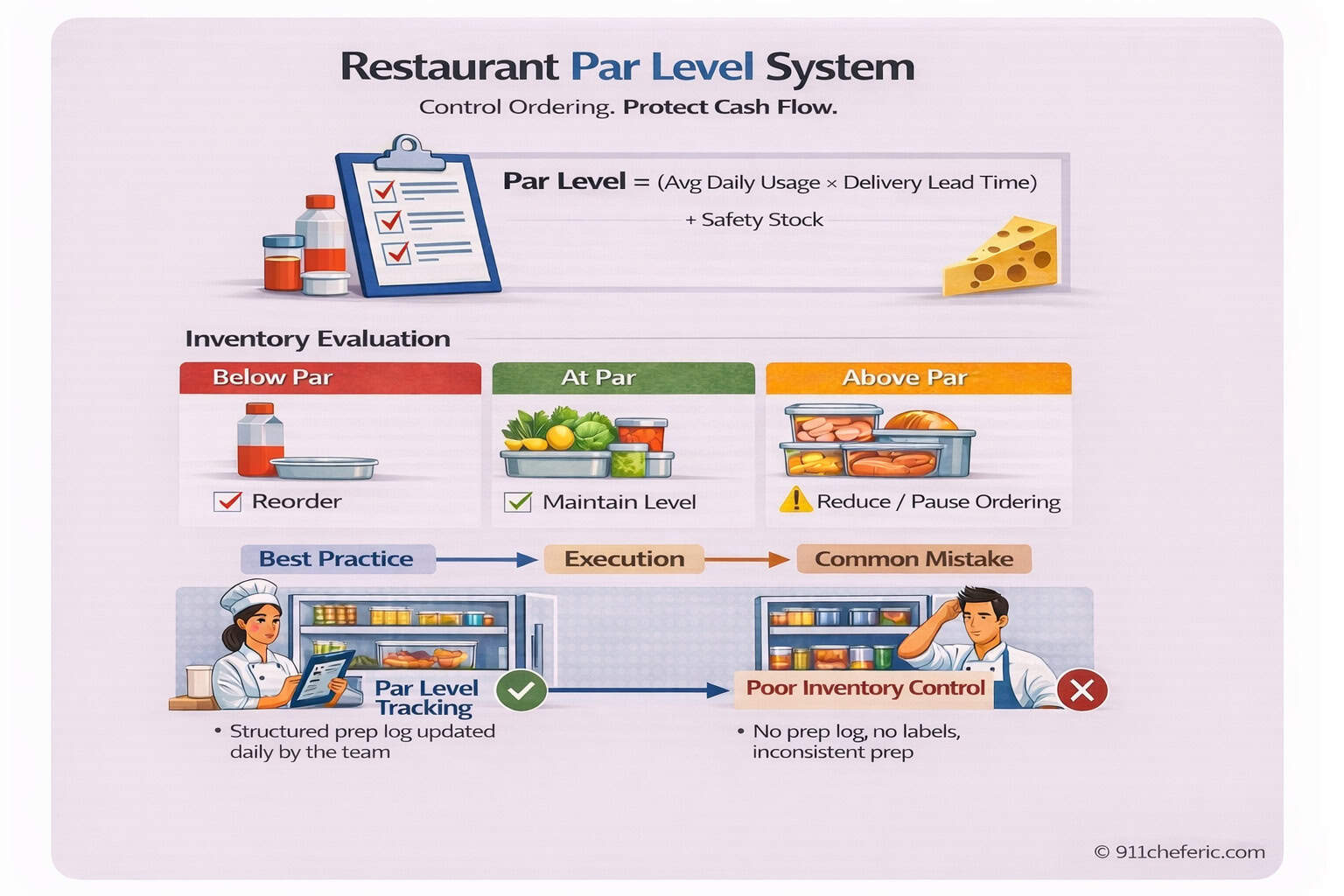
Restaurant par level system implementation determines whether an operation controls inventory or constantly reacts to it. Although many kitchens appear structured, inconsistency often drives decisions behind the scenes.
As a result, excess stock locks up cash, products expire before use, and critical items run out at the worst time. Over time, these issues compound and create both financial loss and operational instability.
For this reason, par levels replace instinct with structure. Instead of reacting, teams follow a consistent and repeatable system.
Over-ordering variance: +4% food cost
Loss: $1,600/week
Annual Impact: $83,200
How a Restaurant Par Level System Controls Ordering
Without par levels, teams rely on memory, pressure, or supplier suggestions. However, once a structured system is in place, every purchase follows a defined rule.
Rather than guessing quantities, operators compare current stock to a set threshold. Consequently, decisions become predictable and consistent across the operation.
Par Levels → Decision
Waste Tracking → Correction
What Par Levels Actually Are
Many operators assume par levels represent minimum quantities. In reality, they function as operational control points.
A par level defines the ideal stock required to support your sales cycle while maintaining stability. More importantly, it establishes a clear decision rule for ordering.
Whenever inventory drops below this level, you reorder. Conversely, when stock exceeds it, purchasing stops. Therefore, guesswork disappears from daily operations.
The Par Level Formula Explained
Average daily usage connects inventory directly to demand. Meanwhile, the delivery cycle defines how long that inventory must last. In addition, safety stock provides protection against variability.
Together, these elements stabilize operations and eliminate reactive ordering.
How Par Levels Protect Cash Flow
Inventory represents cash sitting on shelves. Therefore, over-ordering reduces liquidity immediately and limits flexibility.
Over time, excess stock creates pressure. Capital remains tied up instead of supporting operations. In addition, spoilage risk increases as inventory builds.
By contrast, controlled par levels keep stock lean and efficient. As a result, turnover improves, waste decreases, and cash flow stabilizes.
Real Kitchen Scenario
Two kitchens may operate at similar volume, yet they produce very different outcomes.
Operator A reacts to pressure and recent sales. After a busy period, ordering increases to avoid shortages. However, when demand slows, excess stock remains unused and eventually becomes waste.
Operator B follows structured par levels. In contrast, ordering stays consistent regardless of short-term fluctuations. Consequently, inventory remains balanced and waste stays controlled.
Ultimately, the difference comes from structure—not effort.
Supplier Influence: Where Most Systems Break
Many operators depend on suppliers for ordering guidance. However, suppliers focus on sales rather than cost control.
As a result, recommendations often increase volume, especially when promotions or bulk pricing are involved. This leads to unnecessary inventory buildup.
Therefore, internal systems must drive ordering decisions. Data—not external influence—should control purchasing.
How Par Levels Drive Daily Decisions
| Stock Level | Meaning | Action |
|---|---|---|
| Below Par | Risk of shortage | Order immediately |
| At Par | Stable level | Maintain |
| Above Par | Overstock | Reduce or pause ordering |
This structure removes uncertainty and reinforces consistency across the operation.
From Par Levels to Kitchen Execution
Par levels define ordering; however, execution determines results. Without control inside the kitchen, even accurate purchasing leads to waste.
In practice, products get received, stored, and prepped inconsistently when systems are missing. As a result, that disconnect creates loss.
To prevent this, strong operations link par levels to production systems. Ordering, prep, and storage must function together.
Prep System → Execution
Expiry Control → Loss Prevention
High-performing kitchens rely on structured systems. For example:
– Each product has a defined storage location
– Prep quantities align with volume and par levels
– Daily production tracks against actual demand
– Expiry dates are calculated and monitored
Because of this structure, planning translates directly into consistent execution.
Many restaurants implement inventory systems; however, fewer build execution systems. True control exists only when both operate together.
Connection to Inventory and Waste
Par levels integrate with broader control systems. Inventory provides visibility, while waste tracking identifies loss.
Inventory Management System
Waste Tracking System
Theoretical vs Actual Food Cost
Together, these systems create real operational control rather than isolated actions.
Building Inventory Control Skills (Online Culinary School)
The Online Culinary School provides structured training in inventory management, food cost control, and kitchen systems.
Through these programs, operators move from reactive habits to data-driven execution.
Strategic Takeaway
Par levels transform ordering into a controlled system rather than a reactive task.
As a result, inventory stabilizes, waste decreases, and cash flow improves. More importantly, decision-making becomes consistent instead of emotional.
Ultimately, the goal is not to order better—it is to remove variability entirely.
If your ordering is inconsistent, your system is broken — not your team. — Chef Eric
Frequently Asked Questions
What happens if par levels are set incorrectly?
Incorrect par levels create overstock or shortages. Regular review keeps them aligned with actual usage.
Should par levels change weekly?
Review them regularly. Fast-moving items require frequent adjustments, while stable products change less often.
Can suppliers set my par levels?
No. Suppliers focus on sales. Internal data must define your par levels.
How do par levels reduce food cost?
They prevent over-ordering, reduce waste, and stabilize inventory, keeping food cost aligned with targets.
Get Practical Restaurant Systems Insights
Learn how to control ordering, reduce waste, and build systems that protect your margins and stabilize your operation.
If your ordering is inconsistent, your system is broken — not your team.
Book a Free Consultation