
Restaurant Inventory Management System
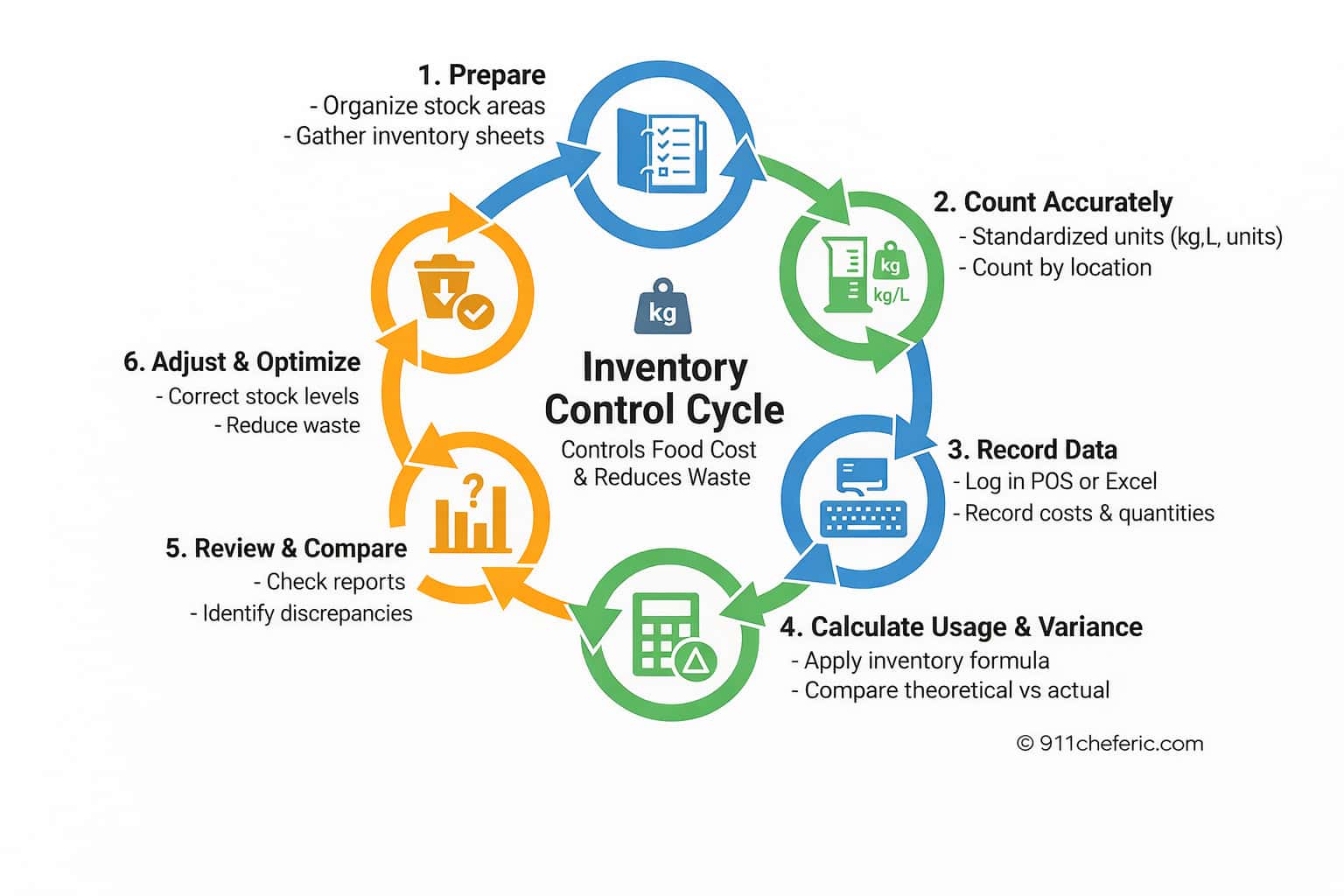
Restaurant inventory control cycle system illustrating the 6-step process used to manage food cost, reduce waste, and maintain operational control through structured inventory management.
Restaurant inventory management system is not a counting process. Instead, it functions as a control system that determines whether your food cost is accurate or misleading.
More importantly, inventory accuracy directly impacts your restaurant prime cost, which combines food and labor cost into your most important profitability metric.
A restaurant control system depends on accurate inventory measurement to validate food cost, identify loss, and maintain operational control. As a result, operators gain clarity on real performance rather than relying on assumptions.
Most operators assume inventory issues come from ordering. However, cost leakage actually occurs across purchasing, storage, prep, service, and waste.
Inventory is the measurement layer of your restaurant control system. Therefore, it validates whether purchasing, production, and waste are aligned with expected performance. Over time, it becomes the reference point for food cost accuracy.
For full financial control, refer to the restaurant cost control and profitability system.
Where Inventory Leakage Actually Happens
Inventory loss rarely occurs in isolation. Instead, it spreads across multiple operational layers; as a result, each layer compounds the next and increases financial impact.
| Leakage Source | Type | Impact |
|---|---|---|
| Food spoilage | Storage loss | Direct inventory shrinkage |
| Overproduction | Kitchen waste | Margin erosion |
| Portion inconsistency | Production variance | Food cost inflation |
| Plate waste | Customer behavior | Lost product value |
| Service failure | Revenue leakage | No repeat business |
To address loss directly, implement a restaurant waste tracking system. In addition, this allows operators to identify where inventory is being lost in real time and take corrective action.
Inventory System Formula: How Food Cost Is Actually Calculated
This formula only works when inventory counts remain accurate and consistent. Otherwise, distorted inputs produce unreliable reporting and flawed decisions.
To understand variance in detail, refer to theoretical vs actual food cost. This connection shows how inventory performance directly impacts food cost accuracy.
Waste Management Is Inventory Control
Inventory and waste are directly linked. In other words, waste represents inventory that was purchased but never monetized. Therefore, every unit of waste directly impacts food cost and profitability.
For instance, production errors, over-prep, portion inconsistency, and service mistakes all contribute to measurable loss. Consequently, these issues compound quickly if not tracked and corrected.
Weekly Inventory and Variance Control
A structured system requires weekly review to maintain accuracy and detect issues early. In addition, consistent tracking allows operators to identify trends and correct inefficiencies before they escalate.
Without a feedback loop, inventory becomes historical rather than actionable. As a result, operators lose the ability to control outcomes in real time.
From Inventory Measurement to Ordering Control
A restaurant inventory management system measures performance. More importantly, it shows what happened, where losses occurred, and how food cost is impacted.
However, measurement alone does not fix the problem. To control future outcomes, operators must implement a restaurant par level system.
Inventory shows the problem. Par levels control the outcome.
At the same time, inventory performance feeds directly into your restaurant prime cost. When inventory is inaccurate or inconsistent, food cost increases and profitability becomes unstable.
Inventory does not create profit. Control does.
Strategic Takeaway
Inventory is not about counting—it is about control. More importantly, it determines whether the operation runs predictably or reactively.
When systems align, costs stabilize and profitability improves. As a result, operations become predictable and controllable.
Frequently Asked Questions
How often should inventory be done?
Inventory should be completed weekly to maintain accuracy and detect operational issues early. More importantly, consistent inventory allows operators to compare theoretical usage against actual results, identify variance, and correct inefficiencies across purchasing, production, and waste systems.
What is inventory variance?
Inventory variance is the difference between theoretical usage and actual usage. Therefore, it reveals where product loss, over-portioning, waste, or process breakdowns are occurring within the operation.
How do restaurants reduce food waste?
Restaurants reduce food waste by aligning inventory tracking with production control, waste tracking, and ordering systems. As a result, operators can identify inefficiencies and correct them before they impact profitability.
Improve Restaurant Inventory Control and Food Cost Stability
Structured inventory systems improve food cost accuracy, reduce waste, strengthen purchasing control, and stabilize restaurant profitability.
Work with a restaurant consultant in Vancouver BC to improve inventory systems, operational controls, food cost management, and overall restaurant performance.