How to Do Restaurant Inventory (Inventory Control System)
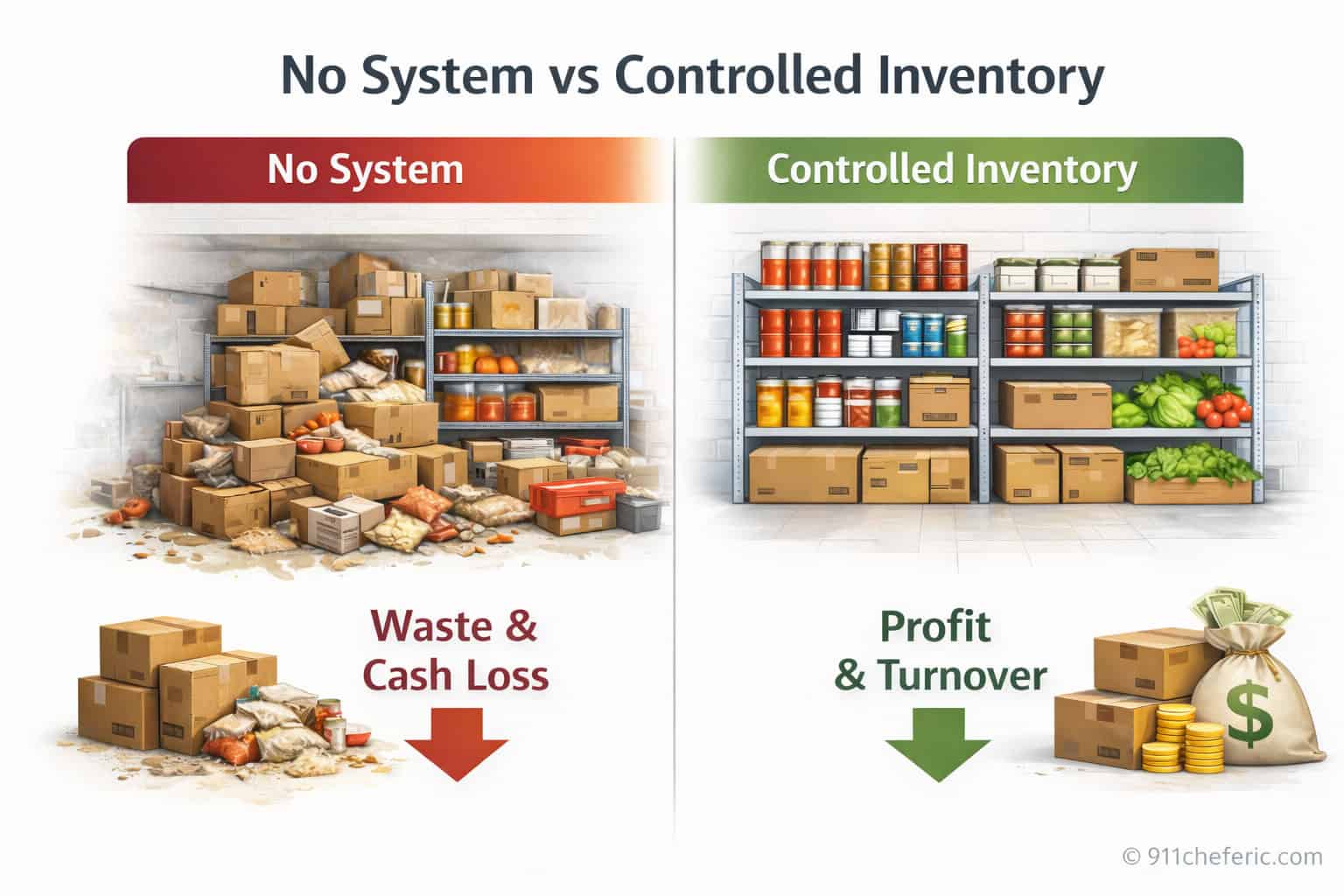
Comparison of uncontrolled vs structured restaurant inventory systems showing how poor inventory leads to waste and cash loss, while controlled systems drive profit and turnover.
How to do restaurant inventory is not about counting products. Instead, it focuses on controlling profit. More importantly, if you are not actively managing inventory, you are likely losing between 4% and 10% of your revenue through waste, over-ordering, and poor operational control.
Most operators believe they are “doing inventory.” However, in reality, they simply count products without making decisions. As a result, numbers get recorded, but nothing changes—and profit continues to leak.
Therefore, inventory must function as a control system. In practice, every product purchased must have one objective: to be sold and generate profit. Otherwise, it becomes dead stock—money sitting on a shelf losing value.
For full financial control, refer to the restaurant cost control and profitability system.
Reality Scenario: Inventory Is Not What You Think
This situation is common. On paper, inventory appears complete; however, operations still fail. In most cases, products are not aligned with demand, and purchasing decisions remain disconnected.
As a result, cash gets locked into items that will eventually spoil. Ultimately, inventory that does not move is not an asset—it becomes a liability.
Inventory Decision System
| Signal | Meaning | Action |
|---|---|---|
| Not Moving | Dead stock | Stop buying, create specials |
| Missing | Stockout risk | Adjust par levels |
| Low Levels | Reorder needed | Trigger purchase |
Each inventory cycle must answer these questions. Otherwise, it has no operational value.
Every product you purchase represents money that must generate a return. Therefore, inventory must move.
However, when a product does not move, it eventually spoils, expires, or loses value. As a result, it becomes a direct financial loss.
To prevent this outcome, operators must actively convert inventory into revenue by adjusting menus, running specials, and correcting purchasing behavior.
Inventory sitting on shelves is not neutral—it is sleeping money that costs money.
Do Not Let Suppliers Control Your Inventory
One of the most common failures is allowing sales reps to influence purchasing decisions.
Because suppliers are incentivized to sell more, they will recommend higher quantities, promotions, and additional products.
However, your objective is not to buy—it is to sell.
For this reason, purchasing decisions must always be based on inventory data and par levels—not supplier suggestions.
Inventory Without Par Levels Is Useless
Inventory shows what you have, while par levels determine what you should have.
Without par levels, ordering becomes inconsistent; therefore, inventory quickly becomes unstable.
Inventory Control Scope (What Must Be Managed)
Inventory must cover the entire operation. Otherwise, cost leakage shifts from one area to another without being detected.
| Category | Control Objective | Risk if Ignored |
|---|---|---|
| Food & Ingredients | Control usage and spoilage | Food cost inflation |
| Liquor & Alcohol | Track pouring and shrinkage | Theft, over-pouring, loss |
| Beverages | Align stock with sales volume | Overstock and cash lock |
| Dry Goods & Packaging | Maintain operational flow | Clutter and hidden cost |
| Chemicals & Supplies | Control usage efficiency | Untracked spending |
For example, operators often overlook beverage inventory. However, excessive stock ties up cash without generating return.
Therefore, inventory must be treated as a complete system, not a partial count of food items.
Inventory Systems: Software vs Structured Control
Many operators believe inventory requires specialized software. While inventory apps can be useful, they often add complexity and cost without improving control.
In practice, most restaurants underutilize these tools. Although they pay monthly fees, they still rely on inconsistent processes. As a result, the system becomes expensive without delivering real operational value.
For this reason, I implement structured inventory and par level systems with my clients.
In addition, these systems align inventory with sales and forecasting while guiding purchasing decisions.
They also reduce reliance on multiple paid tools and maintain full operational visibility.
As a result, a well-built spreadsheet or centralized system often delivers stronger results than disconnected apps.
Ultimately, the objective is not to use more tools; instead, it is to build a system that operators follow consistently.
Strategic Takeaway
Inventory is not about counting—it is about control.
If your inventory does not change your ordering, you do not have a system.
Frequently Asked Questions
Why is my inventory always wrong?
Inventory errors come from inconsistent counting and lack of system control. See inventory system.
Who should manage inventory?
Management must own inventory, with verification processes in place.
What is acceptable variance?
1–2% is acceptable. Above 3% requires action. See variance control.
How often should inventory be done?
Weekly for high-value items and monthly for full inventory.
Do I need inventory software?
No. Structured systems are more important than tools. See cost control system.
Get Practical Restaurant Systems Insights
Learn how to control food cost, reduce waste, and build structured restaurant systems that improve profitability.
If your inventory doesn’t change your ordering, you don’t have a system.
Book a Free Consultation