
Restaurant Labor Productivity Metrics: How to Measure Staff Efficiency
Restaurant labor productivity metrics help operators measure how efficiently their teams convert labor hours into revenue. Because labor represents one of the largest controllable expenses in restaurant operations, productivity indicators allow managers to evaluate staffing decisions, improve scheduling accuracy, and protect profitability.
Without structured productivity measurements, restaurants often rely on intuition when planning shifts. As a result, payroll costs increase while operational efficiency declines.
By tracking the right indicators, restaurant operators can align staffing levels with demand and strengthen the broader framework of restaurant systems and operations.
Why Labor Productivity Matters in Restaurants
Labor productivity reflects how effectively employees generate revenue during service. Every labor hour should contribute to guest service, food production, or operational execution.
When staffing levels are poorly aligned with demand, productivity drops. Overstaffing increases payroll expenses, while understaffing damages service quality and slows operations.
For this reason, professional operators track labor productivity alongside other financial indicators such as restaurant labor cost control and prime cost performance.
Sales Per Labor Hour (SPLH)
Sales per labor hour is one of the most widely used productivity indicators in restaurant operations. It measures how much revenue each labor hour generates.
Sales per Labor Hour = Total Sales ÷ Total Labor Hours
For example, if a restaurant generates $4,000 in revenue and employees work a combined total of 50 labor hours, the sales per labor hour would be $80.
This metric helps managers evaluate whether staffing levels support revenue generation. When used together with restaurant scheduling systems, SPLH becomes a powerful operational planning tool.
Restaurant Labor Productivity Metrics
Restaurant operators track several key labor productivity metrics to measure staff efficiency and protect profitability. These include Sales Per Labor Hour (SPLH), labor cost percentage, guests served per server, and Revenue Per Available Seat Hour (RevPASH).
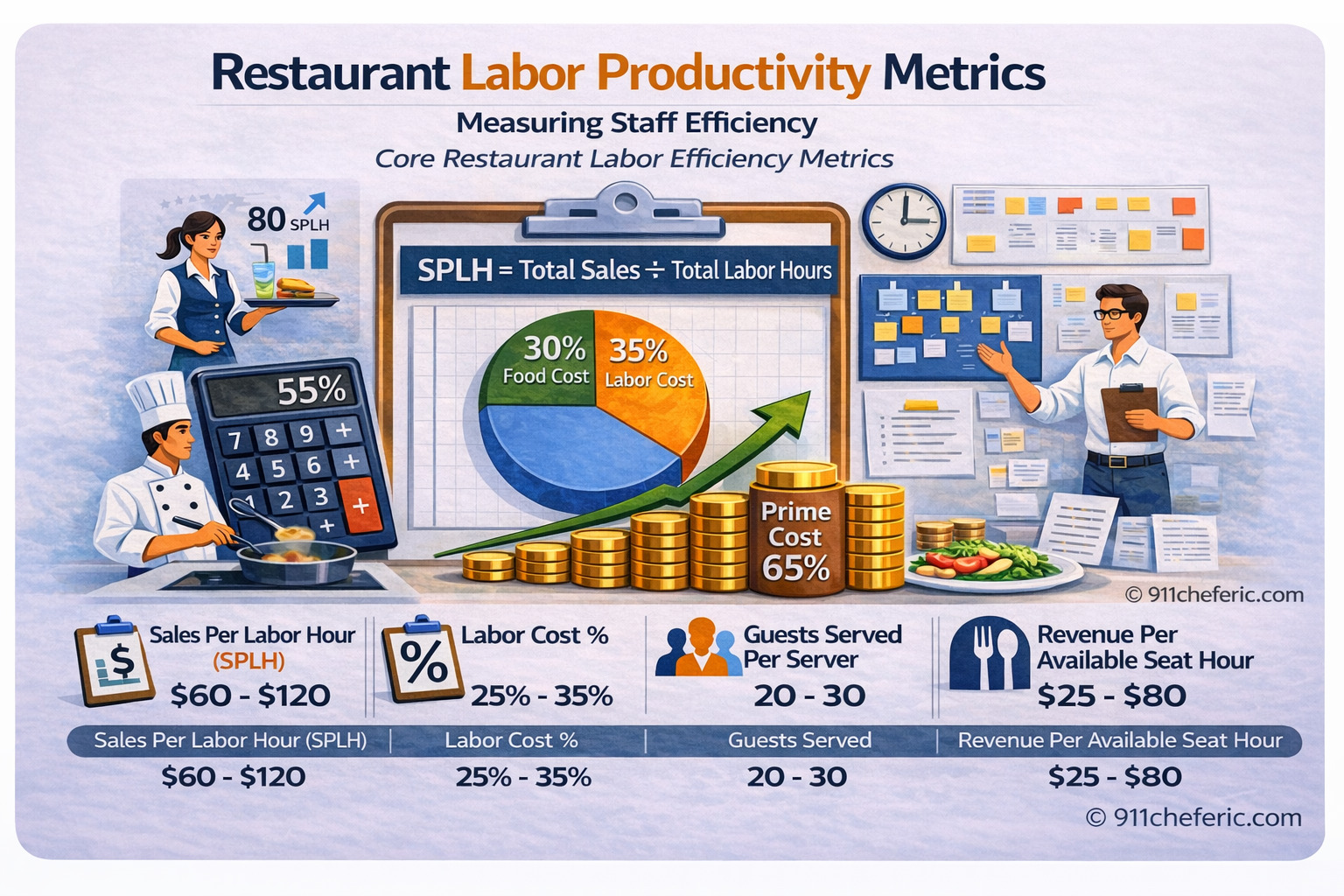
Understanding how these metrics interact allows restaurant operators to diagnose labor inefficiencies, improve scheduling accuracy, and control prime cost.
Typical Labor Productivity Benchmarks by Restaurant Type
| Restaurant Type | Typical SPLH | Labor Cost % | Operational Characteristics |
|---|---|---|---|
| Quick-Service / Fast Casual | $90 – $140 | 20% – 30% | Highly standardized production and minimal table service. |
| Casual Dining | $60 – $100 | 25% – 35% | Moderate service levels with multiple front-of-house staff. |
| Full-Service Restaurants | $50 – $80 | 30% – 40% | Higher service expectations and more complex operations. |
| Fine Dining | $40 – $70 | 35% – 45% | High-touch service model requiring larger service teams. |
Regional Differences in Restaurant Labor Productivity
Labor productivity benchmarks vary significantly between regions due to service models, labor regulations, and cultural expectations.
| Region | Typical Labor Structure | Operational Characteristics |
|---|---|---|
| North America | Higher staffing ratios | Tipping model encourages larger service teams. |
| Europe | Lean staffing models | Employees often perform multiple roles during service. |
| Asia | Varies widely by market | High-volume restaurants may rely on highly efficient staffing structures. |
Because of these differences, operators should treat benchmarks as reference ranges rather than strict targets.
Additional Productivity Indicators
In addition to sales per labor hour, professional restaurant operators monitor several related metrics.
Labor Cost Percentage
Labor Cost % = Total Labor Cost ÷ Total Sales
- Typical range: 25% – 35% for most restaurants
- Fine dining concepts may operate slightly higher
- Quick-service restaurants often operate lower
Guests Served Per Server
This indicator measures how many guests a server manages during service.
| Concept Type | Typical Guest-to-Server Ratio |
|---|---|
| Casual Dining | 20 – 30 guests per shift |
| Full-Service | 15 – 25 guests |
| Fine Dining | 10 – 18 guests |
Labor Productivity and Prime Cost
Labor productivity directly affects prime cost, which represents the combined cost of food and labor in restaurant operations.
Prime cost typically ranges between 55% and 70% of total restaurant revenue. When labor productivity declines, payroll expenses increase and prime cost rises accordingly.
For this reason, operators should evaluate productivity metrics alongside structured restaurant cost control and profitability systems.
How Managers Use Productivity Metrics
Productivity metrics should guide operational decisions. When indicators fall outside expected ranges, managers can adjust:
- Shift schedules
- Staffing levels
- Cross-training programs
- Menu production workflows
Over time, these adjustments improve operational efficiency and strengthen financial performance.
Developing Restaurant Management Skills
Understanding restaurant labor productivity requires more than tracking numbers. Managers must also understand how labor systems, kitchen workflows, menu design, and service structures interact inside a restaurant operation.
For operators and culinary professionals who want to deepen these skills, Chef Eric also developed the Online Culinary School, an educational platform designed to teach the operational systems that drive restaurant profitability.
The program expands on the same frameworks discussed throughout this site, including labor productivity management, restaurant systems, kitchen operations, and menu engineering. These structured learning modules help chefs, managers, and restaurant owners develop the operational discipline required to run profitable restaurants.
Strategic Takeaway
Restaurant labor productivity metrics allow operators to measure staff efficiency and align staffing levels with operational demand.
By tracking sales per labor hour, labor cost percentage, and service ratios, restaurants can maintain stronger control over payroll expenses while preserving service standards.
When productivity metrics are integrated with scheduling systems and prime cost management, restaurants gain the operational discipline required for long-term profitability.
Frequently Asked Questions
What is restaurant labor productivity?
Restaurant labor productivity measures how efficiently employees convert labor hours into sales revenue.
What is a good sales per labor hour in restaurants?
Most restaurants operate between $50 and $120 in sales per labor hour depending on concept, service level, and pricing structure.
How does scheduling affect labor productivity?
Accurate scheduling aligns staffing levels with predicted demand. Efficient scheduling therefore improves restaurant labor cost control.
How do productivity metrics connect to restaurant systems?
Productivity indicators form part of the broader framework of restaurant systems and operations used to manage restaurant profitability.
Get Practical Restaurant Profitability Insights
Receive practical insights on restaurant profitability, labor cost control, scheduling systems, menu engineering, and operational performance.
Or schedule a direct meeting with Chef Eric.
Book a Free Restaurant Consultation