
Restaurant Systems and Operations: The Framework That Runs Profitable Restaurants
Strong restaurant systems and operations are the foundation of profitable restaurants. Although the restaurant industry attracts entrepreneurs because it combines creativity, hospitality, and business, it is also one of the most operationally demanding industries in the economy. As a result, restaurants operate with narrow margins, high labor intensity, and constant cost pressure.
For this reason, successful restaurants rarely succeed by accident. Instead, they rely on structured restaurant systems and operations that control inventory, production, service, and financial performance. Without these systems, even busy restaurants can struggle to maintain stable profitability.
Restaurants rarely fail because of food quality alone. More often, the real issue is that operational systems are inconsistent, undocumented, or poorly enforced.
The Reality of the Restaurant Industry
From the outside, the restaurant business can appear exciting and glamorous. However, the financial and operational realities are significantly more demanding. Therefore, several industry benchmarks clearly illustrate why structured restaurant systems are essential.
Restaurant Failure Rates
| Timeline | Estimated Closure Rate |
|---|---|
| First year | Approximately 17% of restaurants close |
| Within 3 years | Roughly 50% close |
| Within 5 years | Nearly 80% of restaurants close |
Average Restaurant Profit Margins
| Restaurant Type | Average Net Profit Margin |
|---|---|
| Quick Service Restaurants | 6–10% |
| Fast Casual | 5–8% |
| Full Service Restaurants | 3–5% |
| Fine Dining | 2–4% |
In practical terms, a restaurant generating $1 million in annual revenue may only produce $30,000 to $60,000 in profit. Consequently, even small operational inefficiencies can eliminate profit entirely.
Because restaurant margins are typically very narrow, operational discipline becomes essential for maintaining profitability.
The Restaurant Systems and Operations Framework
High-performing restaurants rely on structured restaurant systems and operations rather than isolated procedures. In practice, operational systems stabilize costs, standardize workflows, and ensure consistent guest experiences.
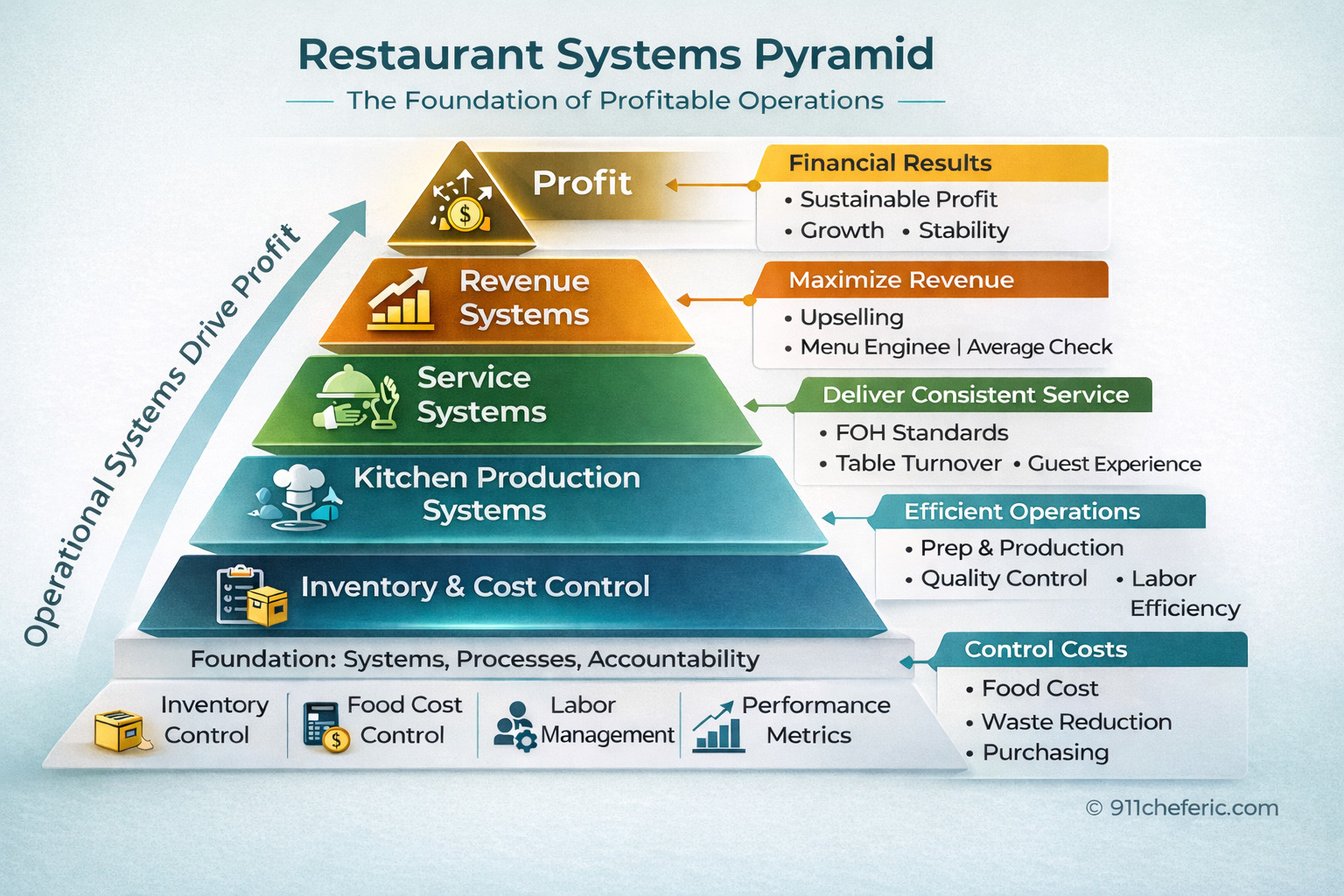
As the pyramid illustrates, restaurant performance is built on layered operational systems. First, cost control and production management create the operational foundation. Next, service systems support guest experience and operational consistency. Finally, revenue optimization systems influence overall profitability.
Why Restaurant Systems and Operations Matter
Restaurants operate in complex environments where dozens of processes occur simultaneously. For example, inventory must be controlled, food preparation must remain consistent, service must run smoothly, and revenue performance must be monitored continuously.
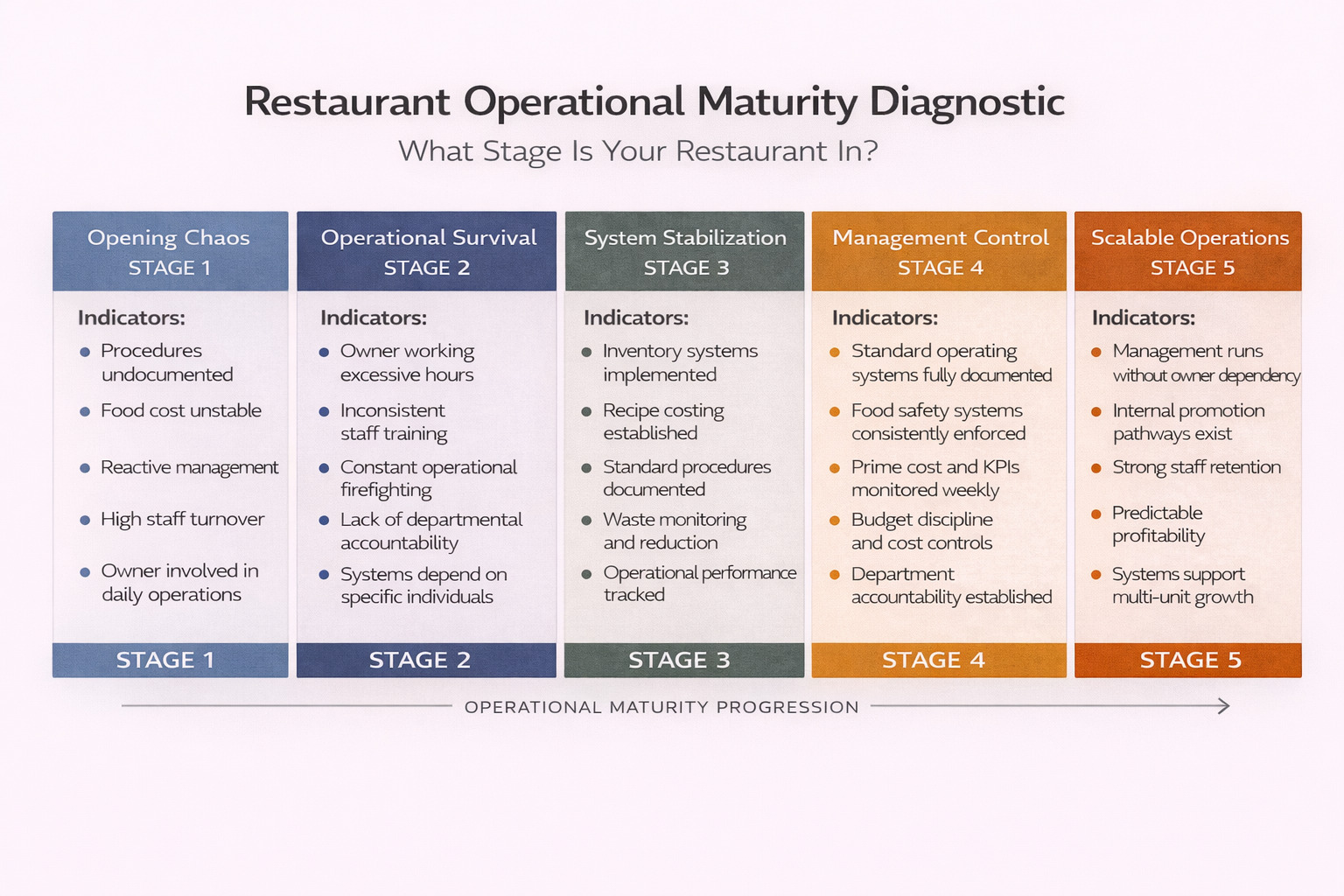
When these operational elements are not coordinated through structured systems, managers often spend most of their time reacting to problems instead of improving performance.
Many operational challenges are not caused by a lack of effort but by inconsistent leadership execution. Through restaurant coaching , owners, managers, and supervisors can develop stronger accountability systems, leadership skills, and operational discipline that support long-term performance improvements.
How Operational Systems Work Together
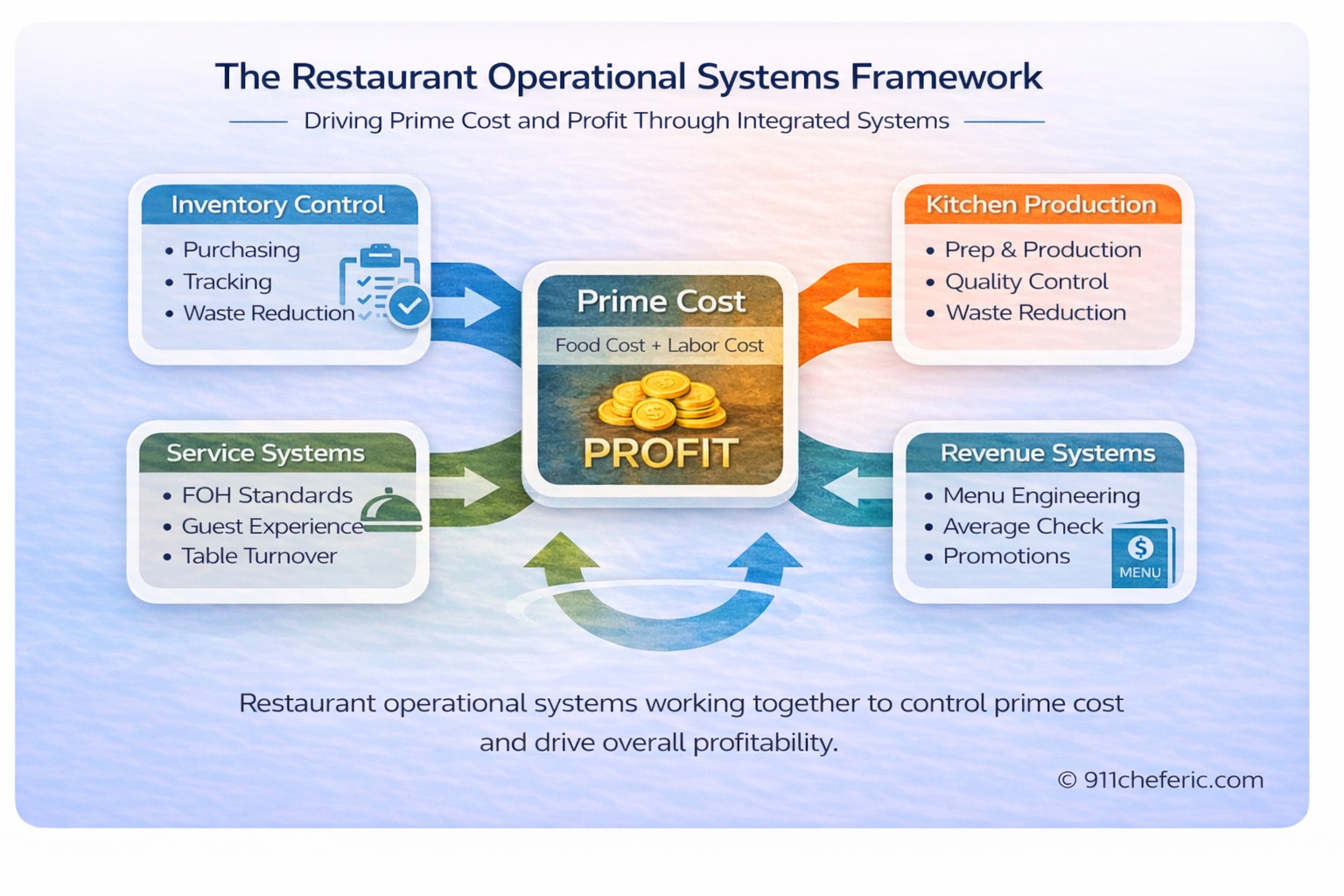
Operational systems interact continuously. For instance, inventory management directly influences food cost, while kitchen production affects labor efficiency. Meanwhile, service systems impact guest experience, and revenue systems influence average check performance. When these systems work together effectively, restaurants maintain stable prime cost and predictable financial results.
Even the best operational systems fail when employees are not properly trained to execute them. Structured restaurant training helps teams follow standardized procedures, improve consistency, and maintain operational performance during busy service periods.
Profitable restaurants are rarely built on talent alone. They are built on systems.
Strategic Takeaway
Most restaurants do not struggle because of effort. Instead, the primary challenge is operational structure. Working with a restaurant consultant in Vancouver BC can help operators identify operational gaps, implement systems, improve accountability, and create a more profitable restaurant operation.
However, when restaurants implement structured restaurant systems and operations, they stabilize food cost, improve labor efficiency, and create predictable financial performance.
Frequently Asked Questions
What are restaurant operational systems?
Restaurant operational systems are structured procedures that control inventory management, kitchen production, service execution, and financial monitoring. These systems create consistency in daily restaurant operations. For example, inventory control systems help operators monitor stock levels and purchasing efficiency. You can explore this topic further in the guide on restaurant inventory management systems.
Why are restaurant systems and operations important for profitability?
Restaurant systems stabilize food cost, improve labor efficiency, reduce waste, and maintain consistent service performance. Without structured operational systems, restaurants often struggle to control their most important financial metric: prime cost. Learn more in the restaurant prime cost control guide.
What is prime cost in restaurant operations?
Prime cost combines food cost and labor cost and typically represents between 55% and 70% of restaurant revenue. Because these two expenses dominate restaurant budgets, operators monitor prime cost closely to maintain profitability. You can estimate your numbers using the restaurant prime cost calculator.
What are the most important restaurant systems to implement first?
Most restaurants begin by implementing inventory control systems, recipe costing, and production planning procedures. These systems provide immediate visibility into purchasing efficiency and ingredient performance. For instance, accurate recipe costing is essential for maintaining stable margins, which you can evaluate using the restaurant food cost calculator.
How do restaurant systems reduce operational mistakes?
Operational systems standardize procedures for ordering, food preparation, portion control, and service execution. As a result, staff follow documented processes instead of relying on memory or improvisation. This reduces operational mistakes, improves training efficiency, and maintains consistent food quality during busy service periods.
What role does inventory management play in restaurant profitability?
Inventory management systems allow restaurant operators to monitor ingredient usage, supplier pricing changes, and purchasing efficiency. Consequently, restaurants can identify waste, control food cost fluctuations, and prevent over-ordering. A detailed breakdown of this process is available in the restaurant waste management systems guide.
Why do many restaurants struggle to implement operational systems?
Many restaurants rely on informal procedures instead of documented operational systems. Therefore, daily operations often depend heavily on experienced managers or long-term staff members. When those individuals are unavailable, consistency breaks down and operational problems increase.
How can restaurant owners improve their operational strategy?
Restaurant owners can improve performance by implementing structured operational systems, financial controls, and management procedures. Education also plays an important role. For example, the Restaurant Mindset and Strategy course explores how restaurant leadership and financial thinking influence operational success.
Build Structured Restaurant Systems That Support Profitability
Strong restaurant systems improve operational consistency, stabilize prime cost, reduce waste, and create more predictable financial performance.
Work with a restaurant consultant in Vancouver BC to improve operational systems, inventory management, kitchen workflows, and restaurant profitability.