
Restaurant Theoretical vs Actual Food Cost: The Gap That Determines Your Profit
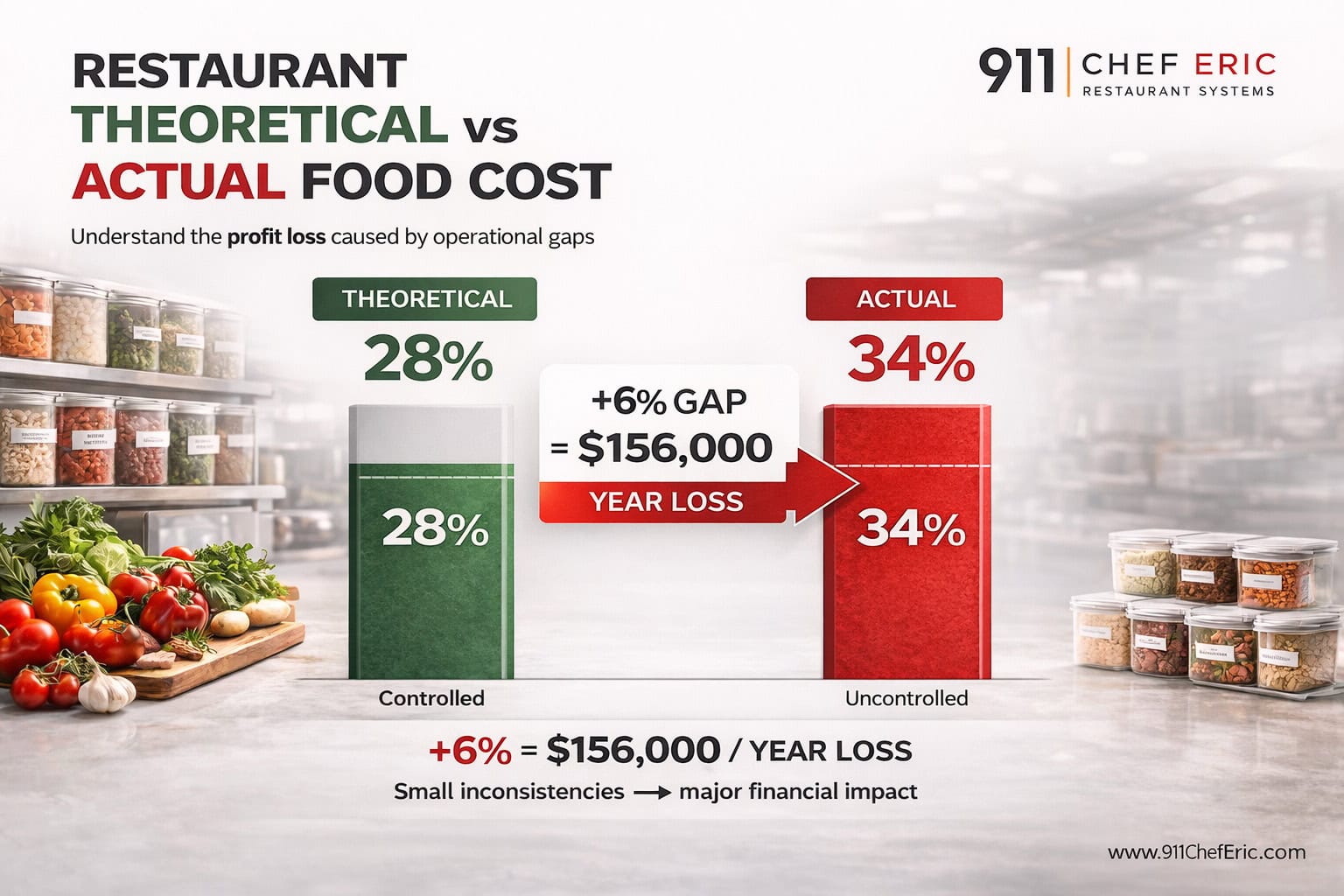
A small gap between theoretical and actual food cost can create massive hidden profit loss in restaurant operations.
Restaurant theoretical vs actual food cost is not just a metric — it is the most accurate indicator of whether your operation is under control.
In most restaurants, this gap is misunderstood, ignored, or misdiagnosed. However, it directly determines whether profit is protected or lost.
At a system level, theoretical cost represents your design. Actual cost represents your execution. The difference between them represents operational failure.
More importantly, this gap directly impacts your restaurant prime cost, which determines overall profitability.
Understanding Restaurant Theoretical vs Actual Food Cost
Theoretical food cost is calculated based on recipes, portion control, and menu pricing. It assumes perfect execution.
Actual food cost reflects reality. It includes waste, over-portioning, spoilage, inventory errors, and operational inconsistency.
Therefore, the gap between theoretical and actual food cost is not random — it is the measurable result of how your kitchen operates.
Actual = executed cost
Gap = uncontrolled operations
Where the Gap Comes From in Real Operations
In practice, the gap does not come from one major mistake. Instead, it comes from small, repeated inconsistencies.
For example, during service:
– Portions increase under pressure
– Prep teams overproduce to avoid shortages
– Products expire due to poor rotation
– Orders are placed without structured data
– Inventory counts are rushed or inaccurate
Individually, these issues appear minor. However, collectively, they create a consistent and measurable financial loss.
Case Study: The Hidden Profit Loss
Theoretical Food Cost: 28% → $14,000
Actual Food Cost: 34% → $17,000
Loss: $3,000/week
Annual Impact: $156,000
This loss does not come from one failure. Instead, it is distributed across daily operations.
Without a system, it remains invisible and continues indefinitely.
Why Most Operators Misdiagnose the Problem
When food cost increases, operators react incorrectly.
They raise menu prices, reduce portions, or negotiate with suppliers. However, these actions do not fix the root problem.
In reality, the issue is not pricing. It is not suppliers. It is not staff.
The issue is lack of system control.
The System That Controls the Gap
Restaurant theoretical vs actual food cost can only be controlled through systems.
First, a restaurant inventory management system measures actual usage.
Then, a restaurant par level system stabilizes ordering.
Next, a restaurant waste tracking system identifies loss.
Finally, everything connects inside a restaurant control system.
Inventory measures. Waste explains. Par controls. This page validates.
What Controlled Operations Look Like
| Control Level | Variance |
|---|---|
| System-controlled | 0–2% |
| Partially controlled | 3–5% |
| Reactive | 5%+ |
Variance directly impacts your restaurant prime cost, making it one of the most critical profitability indicators.
Frequently Asked Questions
What is theoretical vs actual food cost?
It compares expected food cost based on recipes with real operational cost. The gap reveals system inefficiencies.
Why is my actual food cost higher?
Because of waste, portion variation, and inventory inconsistency. These issues are controlled through restaurant systems.
What is an acceptable variance?
A controlled operation maintains 0–2% variance. Higher variance indicates system failure.
Diagnose Your Restaurant System
If your theoretical and actual food cost don’t match, your system is not under control.
Food cost problems are not pricing issues — they are system failures.
Book a Free Consultation